 The first post 8/3/2012 Mike wrote a post the first few weeks of school about how we were trying to teach our students about leadership and impacting the world around them. You should read that post before you read on. On of my student sent me a speech she wrote for her Bat Mitzvah and asked me to read it over. I have taken several sections out for you to read: If you went to my school, and ever participated in social studies class, you would call this a lollipop moment. Now you are probably thinking, wait, did she just say lollipop moment. Well, yes I did. In class one day, our teacher showed us a video of what one person called a lollipop moment. I will describe to you now, the sample that he shared. A girl was very afraid to go to college; she didn’t think it was the right thing for her now and was going to wait until she was ready. Although, her parents convinced her to give the first day a chance, and if she didn’t think it was the right decision, then it was fine, she didn’t need to continue. As she was standing in line, a man walked out in the dorkiest hat ever, and was handing people lollipops. He approaches her and looks at her, then at the boy in line behind her. He hands the boy a lollipop and says, “give this to the beautiful girl next to you.” The boy turned beet red, handed the girl the lollipop, and everyone in the area started cracking up, and at that point the girl knew she was ready for college. The girl felt at that moment, that she could be herself there, and didn’t have to worry about not fitting in, or being who she was, afraid that someone would judge her. Who would think that a simple lollipop could break the ice!
The girl didn’t talk to the man handing out lollipops until four years later when he was about to graduate. She told the man her whole experience, and that she was still dating the boy in line behind her. The funny part is the man didn’t even remember handing her the lollipop! The man created a change in her destiny. In fact, a few years later, he got their wedding invitation.
So what is a lollipop moment ? A lollipop moment is when a person does something for you that is so amazing it changes or impacts your life. The man in the story didn’t even know what he did; after all he just handed out a lollipop. We have all experienced lollipop moments, whether we are the man handing out lollipops or the girl receiving, but we are just never told so. What seems a little event at the time, can later it can result into something huge. In life we don’t always know how important are actions really can be or are....My point is, you can change someone’s life without even knowing it, and have your life changed by someone, without them evening knowing it. You need to be an agent for change. It is just as important to let people know when they have impacted you as well....So right now, let me thank everyone in this room, you have had an impact on my life, and I thank you for all of those lollipop Everyone go home, and hand out your lollipops and think about special moments you have had, because no matter how small they are, they matter. In ways you can’t always see. What we do really does impacts students in major ways and in ways we don't always get to see. Thank you, Olivia for this lollipop moment in my life.
Last night I came across an article concerning the burning down of the Ahmed Baba Institute in Timbuktu. I don't want to get into the politics of this event, since I have not completed any research concerning recent events or the groups involved. What I would like to discuss is the idea of digitizing humankind's written history. First, as a historian, I love artifacts. There is just something amazing about going to a museum or library and holding/seeing something that is thousands of years old. It is just a simple moment of awe when you can be so close to artifacts that have had a significant role in the creation of the modern world. Everything from my Great, Great Uncle's surveying tools used out west during the mid 1800s to the illuminated manuscripts found in the Cleveland Art Museum. I suppose our (Garth and I) fascination with artifacts is one reason why we speak so often about leaving digital footprints worth following. Technology really has changed nearly ever aspect of life. Today's artifacts are digital. They say that once something reaches cyberspace, it is there forever. It is much more permanent than the stone roads of Rome or the castles of Medieval Europe. Our students are creating living artifacts. There legacy isn't something that will be unearthed hundreds of years from now...their legacy is organic; it is ever-changing and developing. People are using it today to learn how kids in our two districts see the world. People are looking at their work and creating a picture of 7th grade learners in Northeast Ohio, much like an archeologist finding a piece of earthenware and deciding what it might say about the people that used it. To this end, I think that it is important that libraries and other academic institutions truly embrace the digitization of the written word. It is very hard to image loosing your cultural identity in this day and age. Students FaceBook and Twitter accounts are an almost permanent record of how they felt about events throughout their lives. It is the reason that I started a Gmail and Facebook account for my three year old. I want her to have a record of her life. It is still too soon to know if there is information that was destroyed in Timbuktu that can never be regained. I can say that if that information had been scanned and saved, then the world may have lost the physical artifacts, but the knowledge (which is the important part) would be safe. Beyond digitization, this information needs to be made readily available to whomever wants access to its knowledge. When I was in college it was the world of JSTOR. This encrypted digital library housed academic information, so of course we can't just let anybody see it ! I'm joking of course, but the implication to password protection and fee-driven digital archives is nothing more than the ancient art of controlling people by controlling information. If you are poor or do not attend college, than we do not want you reading the most recent research. Ideas like GoogleBooks and The Miller Center are great examples of how information can be made freely available to anybody with the passion to find it. I encourage everyone to activity fight for the digitization and liberation of information.
When I was twelve, every week was the same. I would spend Sunday to Friday night looking for quarters. I had one goal: to spend Saturday morning at the grocery store playing Pac-Man, while my mom got our weeks worth of food. The game was way up front by the doors and I remember many times as my mom waited for me to finish. I memorized the pattern of that game and can still clear levels from memory. As a parent, I watch my son play hours of PS3 or get online to play games. I have tried to get into the PS3, but to no avail However, this weekend I started playing this online game. I showed my son and saved the site to my diigo bookmarks. Zach was all over it and to my surprise, I was as well. The game is called "GoodGame Empire" found at http://empire.goodgamestudios.com/ . It is free and based on the Middle Ages. Kinda a SimCity of the Medieval period. BTW, if you start playing look me up dgholman, my screen name and castle. I am teaching about the middle ages right now at school. Mike and I use the Middle Age Webquest (an autonomous mastery learning model-- read about it here and see the live version here) for student learning. So, anyways I posted this link to my Diigo and shared with the MrHolman/Pennington group. I was sure no one would read it on a three day holiday weekend, and a snow day as well. However, when I went to school today, seven kids came to see me right away (all boys) and had started building their manors and wanted to show me. They all had stories of battles and what they had built and what they planed to do next. They were learning economics, military strategy, jobs, following directions and solving problems with a limited number of resources. Below are a few images of there manors by day three or four. I started an alliance to help my son, but now everyone from school is joining so we work together to hold our own or expand our empires with about 70,000 other castles (individual players) in the game: we will work together to achieve some online goals. I will keep you posted and update our progress and pitfalls, but CLEARLY they read that diigo feed, even on weekends. That is cool and as Zach says, "Dad, these are not the stupid games you used to play." He is right:)
Over the summer I was in Dallas, presenting as a guest of the ASCD (Association for Supervision and Curriculum Development of Texas). I was doing two presentations: Student's Leaving a Legacy and Creating the 21st Century Assignment. It was the last time I presented and I had to be at the airport for a flight home in a few hours. I was in the grand ballroom with about 75-100 people for the 21st Century assignment presentation and was in a zone. I was very excited to share what Mike and I and our students were doing and how we were changing teaching and learning. The whole presentation is about using all the technology tools together to create autonomous mastery learning the rule, not the exception. About 30 minutes in a women, who had raised several difficult questions (seemed to question all I was saying, however, in the end I think was very supportive of what I was talking about) said, "So you are an outlier, right?" I made a reference to Malcolm Gladwell (" Outliers: The story of success"), but said no and moved on. Her question has stuck with me for seven months. So this winter break, I re-read Gladwell's book and have a more detailed answer to her question. What I said to her was not really true. Mike and I are outliers, our students our outliers, we are different from the mass of 7th grade classrooms around the country. I will use one example from Gladwell's book and then try to explain how it relates to us. Several pages into the book, Gladwell talks about hockey players and how we believe success in hockey is based on individual merit: "Players are judged on their own performance, not on anyone else's, and on the basis of their ability, not on some other arbitrary fact...Or are they?" He goes on, in my opinion convincingly, to show that this individual merit idea is not really how the "real" world works. He uses the roster of 2007 Medicine Hat Tigers (A top traveling hockey team for youth in Canada). The roster tells a story: 40% are born in Jan-March, 30% between April-June, 20% between July-September, and 10% between Oct-Dec. Not only did this apply to the junior hockey team, but to the pro's as well. How can that be? Gladwell explains a few things. First, if you are born earlier in the year, you are stronger, bigger and more coordinated then say a player born 9 months after and you might be seen as more "talented" then others (In schools, change that to the cut off date for starting school!) . Second, once we make the decision of who is "talented" at an early age, they will be provided with superior experiences and develop fastern then others (Does this happen in schools?). Third, he talks about the "Matthew Effect". In his words (p. 30), "It is those who are successful in other words, who are most likely to be given the kinds of special opportunities that lead to further success." The rest of the 300 plus pages explain the success of others and how we (society) help them achieve success. To answer the women in Dallas, we are outliers. We have lots of people to thank for our success and opportunities, we have not done it alone.
Forgot to post a few months ago...sorry  Click for Steve's Blog This is the third time I have worked with Steve Barkley. Today, election day, is our district Professional development day. Steve is speaking to about 200 staff members. We are divided by content areas, so I am at a table with 6-12 social studies teachers. He started our disucssion by talking about the difference between Teaching and Learning (post for my reflections on this idea). Take a look at the chart we discussed below: What are your ideas on this? In your classes and PD, what is the focus?  Using Wallwisher in class If we changed our focus to learning, would our teaching change? As a group we talked about how this idea is impacting our classrooms. It seems the simple answer is, well, maybe. We talked about the common core and new standards for social studies came up and how we as a team are being asked to do many things on the teaching side. However, as a PLC, we are moving toward learning. Steve's next question was, have we targeted student behavior that we want our students to practice to become great? Teams around the room began to talk and debate. Our team said yes! We built it last year. See the image below or click here to see our social studies website. As a group, we agreed on these behaviors as our main goals. This was a major achievement. We went from a group that would meet once a month and point fingers at each other about what the kids did not know. Now we are sharing ideas on how to teach to achieve the above key behaviors and indirectly helping us learn how to teach our content more effectively. Then, Steve asked several questions on how we change student behavior? He mentioned Dan Pink's work, " Drive" [twitter summary: "Carrots & Sticks are so last century. Drive says for 21st Century work, we need to upgrade to autonomy, mastery & purpose." (Pink/203)]. So, here comes technology in my room. Drive talks about autonomy, mastery and purpose. Let's take a look at each idea: 1. Automony: Mike and I have been creating autonomy assignments together over skype and google docs. These are self paced and core content standards based. Check one out! We are encouraging kids to many of the ideas above in class daily. 2. Mastery: These tasks are self paced, with kids having time to become experts on topics that would not be addressed in a normal class. A quote Mike and I like to use when we talk about autonomy, mastery and purpose: "...multimedia technologies, which use text, audio, video, graphics and animation to communicate information, offer today's teachers a mechanism to move from a 'linear' learning environment to a 'nonlinear' environment - one which offers users interactivity, control of progress, and choice in their construction of knowledge." -Cuper and Lambert cited in Hanover Research Council Maintaining Competitiveness in the 21st Century, 2010 3. Purpose: Teaching other kids around the world, youtubes with 26,000 views in a year? I will let the book speak for itself. http://dgh.wikispaces.com/ see the images below.... At this point he moved on to Peer Coaching. He highlighted two coaching beliefs: 1. Everyone working in the school should be observed once a week and receive feedback. 2. The most skilled and professional educators should be coached the most. We talked about the instructional coaching levels: Evaluation (outside criteria), Supervision, Mentoring, Peer Coaching (teacher's choice). In our PLC at the middle school, we have been working on Peer Coaching. The point here is to create learning communities to share best practices, ask questions, and find new ways to do things. I have gotten a great amount of help from the 6th and 8th grade teachers...just having chats with me that shed light on how to do things better. However, this is not required and opens the door for real meaningful conversations.
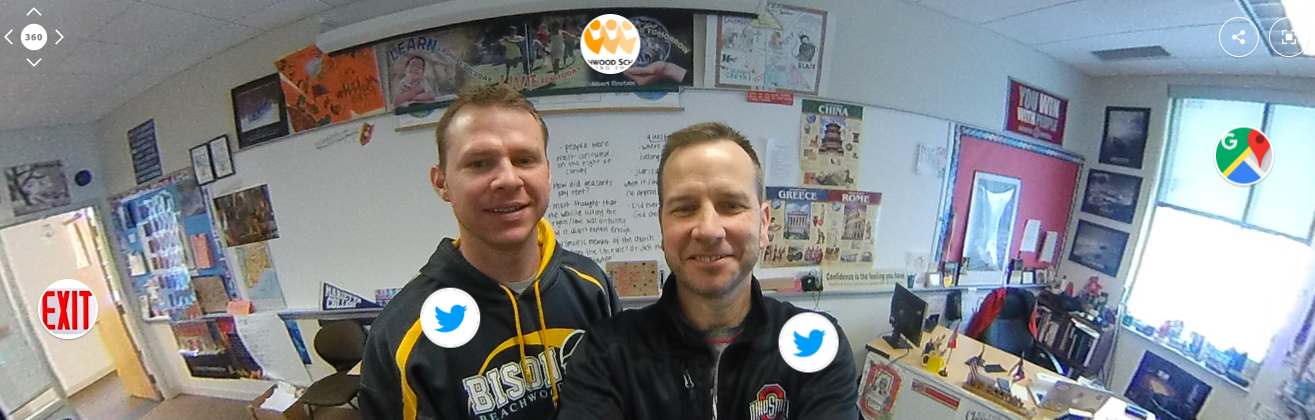
I could not leave this topic without mentioning Mike. Mike and I peer coach each other almost everyday. We talk, reflect, build, argue and learn together. Without Mike, I do not know if I could do everything we write about. We need each other to pull this stuff off and to have a "tribe" (Sir Ken reference: "The Element"), someone to share our frustrations and our learning dips with who will help push us to greater heights. We make each other better teachers.
Please wear Green and White ON MONDAY DEC. 17 to Honor Sandy Hook Please take a moment this week, tomorrow especially, to show your support for Sandy Hook. Send pictures of students & staff wearing green and white and showing their support to Mike (mike@teachersfortomorrow.net). I will splice them into the pictures collect from Chardon Middle School into a movie to send off to Sandy Hook. The pictures I recieved from other schools showing support was very comforting.
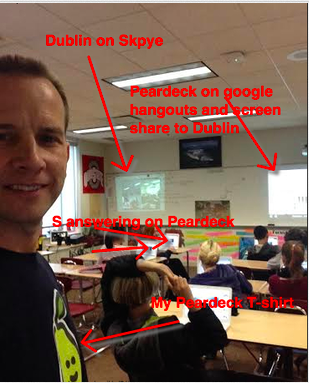
Garth and I would like to take a moment to offer our prayers and thoughts to all of those affected by the actions in Connecticut today and also those that have ever been affected by school violence. It was only ten months ago that my district became the center of international news when violence found its way into our high school. My students were Skyping with Garth's students prior to our lock-down. The emotional toll of that day can still be felt in my building and around the district. I look twice at people in my building I do not know, we hug kids before long weekends and breaks and we cut each other a little extra slack when the emotion of teaching gets to us.
PLEASE take a moment to send cards, letters, gifts, Tweets, and FB posts to the members of Newtown Connecticut. Our teachers still receive cards and my Teddy Bear gift still keeps watch over my students. You have no idea how helpful to the healing process all of the love we felt from the country was to our students and staff. I was home sick today, but the minute I checked my Twitter-feed, I was instantly taken back to that day last February. School will never be the same for those teachers, students, administrators and parents. Sandy Hook Elementary School 12 Dickinson Dr Sandy Hook, CT 06482-1298
Now is not the time to place blame; it isn't about gun control, school security, or mental illness. Leave the speculation and fact-gathering to those trained to deal with it. Our role is now one of support and love for those needlessly murdered and (perhaps more importantly) those who remain alive to deal with this event. Please do not forget the first-responders, firefighters, paramedics, EMTs, police, etc that also must deal with today's events. It is their job to care for those children and teachers. They ran into that building while others where running out. Our local police did not hesitate to enter our high school to help protect the lives of our students. Hug your kids tonight!!
I have been teaching at the University of Akron for 8 years or so. Over the last three-four years, grad students in my class have been keeping a reflective blog on the material we are addressing in class. The goal of this blog is twofold: one to become confident and experienced in keeping a blog for school use and second, as a way to show their understanding of how to integrate technology into the classroom over time. I want to share two of these outstanding sites with you.
Two UA student websites are highlighted by Ohio Department of Education. (click here for list of all 25 sites) Michael S. O'Connor's, has written an outstanding blog, STRANGE TRANSMISSIONS on the power of technology in the classroom. Michael's homepage explains his rational for how technology can change teaching and learning. Mike Pennington loves the tag line on his blog.... wish I had Jedi powers and owned a lightsaber! Check out his work. The second student created blog, is called Learning with Betz. The author of this blog, is Rachel Betz, who plans to teach Math and or science in the near future. She has done a great job on her blog. I hope both Michael and Rachel, continue to blog about new and exciting ways to engage students. On a side note, Teachersfortomorrow.net is also on the Ohio Department of Educations website, as a site to follow about Education and technology in Ohio's public schools.
 Allison's blog post Allison Ross, is a soon to be social studies teacher, who is working on her masters at the University of Akron. For a blog post on visual learning she created an outstanding chart of resources for all teachers. I asked her for premission to repost her chart on this site. Below you will find her work and I hope you check out her blog as well.
Good morning! Welcome to our presentation on Creating 21st Century Assignments: Self-Paced Mastery Learning in a Flipped Digital Environment. Below are the links we will use and the PowerPoint that will encompasses our presentation. We tend to be organic when we present, jumping around to websites and ppt slides. Please feel free to cruise the internet and ask questions as the presentation progresses. Click to link...Combined Classroom BlogProfessional BlogStudent-created online textbook
I was sitting in my classroom after school, attempting to catch up on some grading, when the Language Arts teacher popped her head in the room. She teaches next door to me, has for two three years and she attended the Akron University Digi-Camp for teachers this summer, where Garth and I had several workshops. She has been experimenting with screen-casting for the sake of making her lessons, homework help, etc available via her website for students (flipped teaching). She wanted to tell me that she created her first screen-cast lesson with a live class!! She said she explained to the students what she was doing and the kids loved it! They were polite and asked questions and took turns speaking...she couldn't say enough about what a positive experience it turned out to be.
This is a great example of how amazing students can be when they are allowed to be part of the learning process. Whether she was aware of it, or just trying to save herself some time (why teach a lesson to an empty class for the sake of screen-casting) she had empowered her students. The kids became part of the lesson! They knew that the lesson would be available to help them and other students learn. She did the single best thing a teacher could do, she gave up control to the students. I was very happy to hear her success. I know, as well as many of you reading this, that when we have a positive first experience with something, we are much more likely to do it again.
There are several teachers in my building that have begun a renaissance in their teaching careers because of technology. The above mentioned Language Arts teachers is a great example, but there are others too! The Language Arts teacher on my Team just started using blogging with her students. She has started a Weebly website and is embedding documents, blogging and sharing information like never before.
The math teacher next door to me took a great technology PD course last spring (not taught by me) and spent the rest of last school year asking tough (reflective) questions of himself and his course. This year he is creating flipped lessons, experimenting with ways to reduce lecture and increase learning and even trying to have "paperless-weeks" in his math classes.
Our 6th grade science teachers have created nearly an entire year's worth of lessons via their Weebly sites. There are built in videos, PowerPoints, quizzes via GoogleDocs, websites and other resources.
Last spring one of our 7th grade science teachers had his students collaborate on a Wikispaces project concerning animal adaptions. he made it possible for his students to become published thinkers, able to share and collaborate between classes and with the world.
The new 7th grade social studies teacher (she teaches the same thing I do) is a techie and has brought her passion of technology to the classroom. Not only is she having kids "Tweet" and blog, but she is starting to collaborate with Garth and I. This means another 120 students will be connected to the work of Garth's students and my students. She even downloaded the weebly app so she could look at her students work on her phone...grading, there's an app for that!
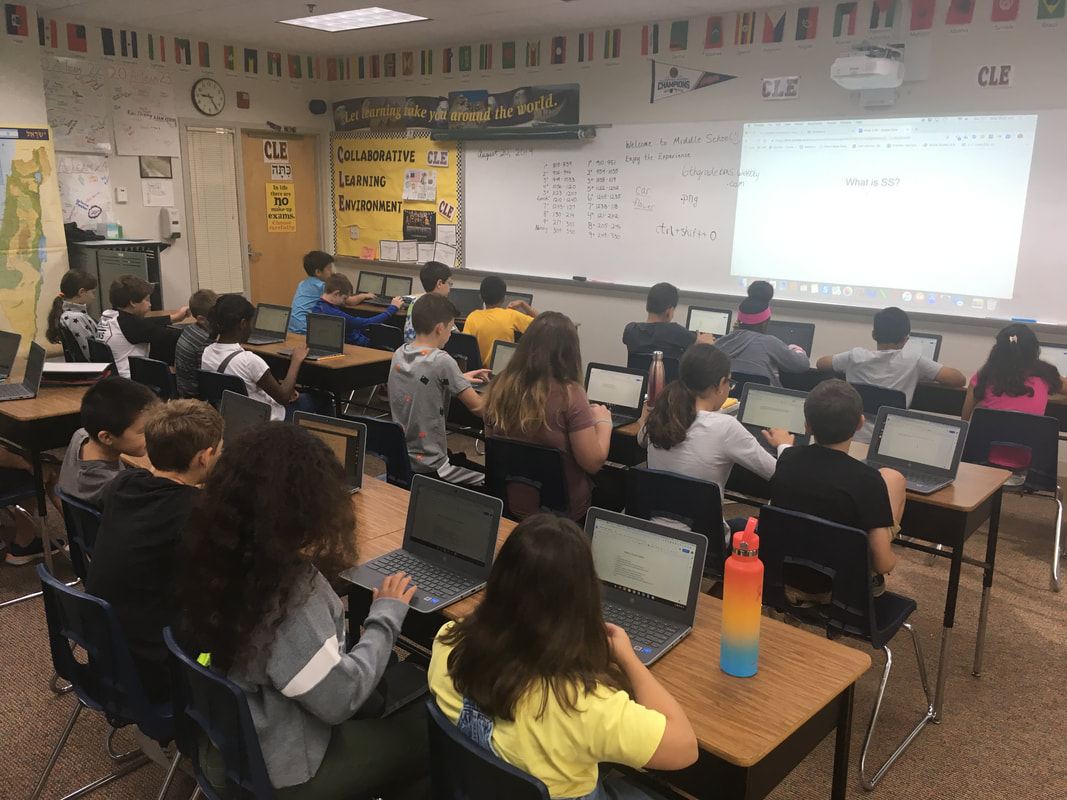
Our Physical Education teachers have been working hard to create an amazing website and digital tools to keep up with the new state standards and our internal attendance system. They are using their iPhones, iPads and laptops to bring technology into the gym. They have created a series of movies starring the students participating in different P.E. activities, then those films are used to help students study and take exams concerning those activities. It is all very, very impressive work that does not get enough credit!!!
It has been a very pleasant change for me professionally. I was starting to get used to the idea that the philosophy and passion Garth and I share on this webpage may never change my own district, let alone my own building. I know change happens slowly and I am a pretty patient person, but it was starting to really bring me down. It is very inspiring for me to see so many passionate teachers embracing technology to empower their students to become autonomous learners. My goal is to feature each one of these amazing teachers in their own blog postings over the next few weeks, so please check back for some inspiration.
-Mike
|