21st Century Skills
 
Picture
This is the second year that Garth and I have used the Middle Ages WebQuest we designed last winter.  As students were completing the WebQuest last year, Garth and I kept seeing things we could change.  Over the last two weeks Garth and I made some major revisions to the project.  Although this is only the second year we have used this WebQuest, it is practically the fourth time we have changed virtually every aspect of it.

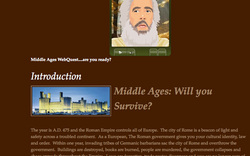
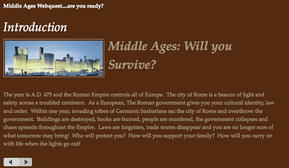
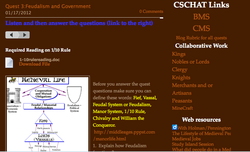
This standards-based Webquest covers the Middle Ages and includes: the Fall of Rome, Feudalism, socioeconomic systems, The Holy Crusades, the Black Death, 100 Years War, Magna Carta and The rise of the Roman Catholic Church.  Infused in each Quest are several elements.  Garth and I have created podcast lectures (flipped teaching) which are attached to a GoogleDoc Form with questions that allow students to reflect on the lecture they listened to, collaborative documents so that students at both schools can share information, a live Diigo stream for our classroom Diigo group, imagery, films, supplemental reading and a few other resources for students to gain depth of understanding and encourage Independence learning.  Each student is required to create a blog post on their website with answers to the Quest questions and a historical narrative written in 1st person about their Middle Ages person's life.

Below is a quick conversation between Garth and I about the changes we have made for this year's students.

-Mike
 
 
Picture
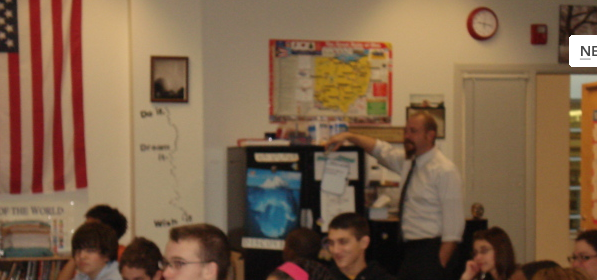
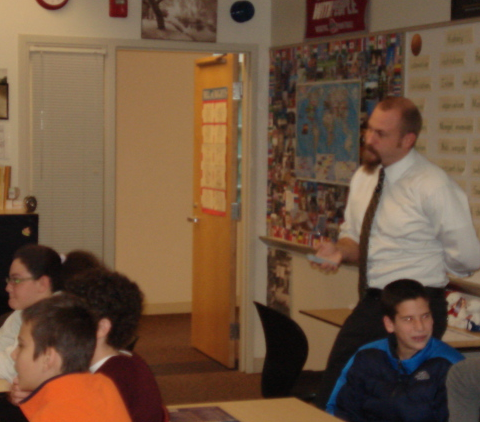
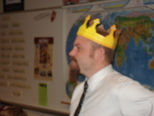
While my school is on winter break, Garth and I thought it would be cool for me to spend the day in his classroom, physically not virtually.  The way our school schedules run, Garth will be able to come and visit my students the first week we are back in school.  Today my job was to introduce students to the Middle Ages Webquest that both schools will be collaborating on for the next 6-9 weeks.  This was the first time Garth's students have ever seen me in person.

It was a pretty overwhelming experience being here in person with a group of students I have only collaborated with via Skype.  The most surprising part of the day was that the students rather quickly accepted me as their teacher.  I was able to talk with Garth, teach the students and carry on as though I was in my classroom.  As the day went on even some 8th graders that recognized me came in to say hello.  The whole experience of the day really helped to remind me of the great experience Garth and I are providing for these students.  It was also a "life coming full-circle" moment for myself since this was the first week I came to Garth's room as a student-teacher 6 years ago.  In a few weeks, when Garth visits my classroom, he will post what his day was like.


Picture
Mike and I finished the middle age webquest a few weeks back.  Today we Skyped and talked about the success, weakness and how we will change this for next year.  We talked about the webquest a few months back before we started it, click here for that post and podcast.

So today's discussion was really about how much the kids enjoyed and engaged in curriculum through this webquest.  In total, students put in about 12 weeks worth of work on their journals, blogs, questions/answers, Voki's, Xtranormals, etc.  I have to admit by the end I was growing a bit bored with the Webquest, but students were still engaged.  Both Garth and I agree that the amount of writing and reflecting students did far exceeded anything up to this point this year.  Students enjoyed the independence and creative freedom of the WebQuest. 

Some of the things we are looking at editing for next year are the quizzes, some of the Quests themselves and the format of the entire WebQuest.  This year the entire WebQuest was hosted on a single web page.  We think that this got a bit confusing and clustered.  Next year each Quest will have its own page.  This will also allow us to put the essential questions, Computer-side chats and any videos we may have at the top of the Quest.  Students will be required to listen to the Computer-side chats and answer a few reflection questions before moving on to complete the Quest.

We are also planning on consolidating some of the Quests; combining similar elements and revising our quizzes.  As Garth and I were grading quizzes we noticed that the students whom were struggling (remember they had to re-take the quizzes for mastery before they could move on) had some great short answer responses and their journal/blogs showed great insight.  The reason, as we see it, is that we have them doing this great WebQuest where they are using higher-level thinking skills to master information and then show how that information would effect the life of their fictional feudal person; while the quizzes were multiple choice.  The assessment did not fit the project.  The quizzes were really just their to "prove" through data that students were learning.  Next year few, if any, multiple choice and a few short-answer questions.

As we have moved onto the Renaissance and the Reformation, some of Garth's students commented that they would have loved to follow their feudal person into these new time periods.  We are thinking about giving each student a "past-self" to follow throughout the entire course.  Garth and I want students to really gain an empathetic understanding of the story of history.  We want the students to create their past-self's history and thus explain the journey of us.  Big goals, but totally attainable and this new focus have Garth and myself determined to implement some ground-breaking projects for next year.

As always, any comments or ideas please do not hesitate to leave us a comment.

-Mike


Picture
Student Created Coat of Arms
Mike and I worked on a Middle Ages webquest for several weeks via google docs, skype and our classroom blog.  We talked about the webquest for a month or more, but when it got to building it we finished it up in a little over a week. 

The webquest is based on a constructionist approach to teaching and learning.  We created podcast lectures, links and guiding questions, but allowed students to explore and play while working.  Each student then created blogs to describe the life they "are living" as a person during the middle ages.  The following are examples of their reflections and growth. 

A "Knight" on his "Castle" being attacked: his real age 12.

I was woken up at dawn by my squire.  He told me that the king had ordered all of his knights to report to his castle.  I packed up my things, suited up, and me and my squire were off.  We left at midmorning and reached there by evening.  The king had ordered a meeting with all of his top officials and knights.
"Welcome my loyal servants.  You may be wondering why I have ordered you to come here.  Recently, my guards have caught a spy from our neighboring kingdom.  After putting the spy through rat torture-" a few despicable men snickered here, "we have found out that they are planning an attack on us within the next three days.  Now we must prepare ourselves for war."
The next two days, I was ordering around soldiers and preparing for battle.  The weapons were sharpened, the greek fire prepared, and the water was boiled.  Finally, they came.
It was midmorning when they arrived.  My squire quickly dressed me in armor, and we went to the king.  He ordered each of the knights to a different part of the castle.  I was on the northern wing, the side that would be attacked first.  I was in charge of the archers.
I saw the enemies marching forward.  The trebuchets loomed in the distance.  Our men stood tense.
As the soldiers marched closer to us, the king and his advisors rode out to meet the enemy king. After a half an hour or so, they rode back.  The red flag was raised, meaning we were still going to fight.
The attacking generals rode in front of their men.  All of a sudden, they turned and charged.  I saw one of my men flinch.
"Hold steady, men!" I yelled.
"Hold," I screamed as they got closer.  One of my men accidentally loosed an arrow.
"FFFIIIRRRREEEEEE!!!!"  The arrows blackened out the sky.  The oncoming men fell by the hundreds.
To counter, the enemies unleashed a deadly array of fiery stone.  The stones pounded our walls, but they held fast.
"FFFIIIRRRREEEEE!!!!" I yelled once more. The next series of arrows was unleashed.
The enemies had now begun to climb up their ladders.
"GRAB YOUR WEAPONS!".  All the men took out their swords and spears.  As the men came up, we chopped them down.  Some of the ladders were covered in Greek fire. We pushed down the remaining ladders after that.
Next came the siege towers.  My men were pegged down from behind protective walls.  Finally, we were able to take them out.
I look at the trebuchets.  One of them fired.  I watched the stone sail through the air.  It hit a large hole where an arrow slit had been before.  I watched in horror as the wall crumpled. 
The oncoming soldiers cheered, sensing victory was near.  Then I had a brilliant idea.
I led my remaining men to one of the tunnels.
I yelled, "Protect the king!"
My men and I ran into the tunnel.  We took a secret passage that led to a tower.  The enemies thought that the king was there, and had kept going down the tunnel.
I listened to their screams as they were burned by the Greek fire thrown down by the men up top.  They were trapped in a fake passage.  Then my men and I came out and finished them off.
After the battle was finished, I was personally thanked by the king.  Then I went back to my nice manor, and rested.

On the Crusade: another Knight heads off,

I rode into the king's palace.  I was immediately greeted by two servants, who washed and dressed me.  Next, I was led to the king's quarters, where he had called a meeting of all of his knights and nobles.
  "My loyal servants, I fear that another war is upon us.  Our new pope, Pope Gregory VIII, has begun a new crusade, and has asked for our allegiance.  Seeing as how we are all children of God, we have no choice, but to join the Third Crusade."
  All of the knights and nobles jumped up and started shouting at the same time.  An uproar went up.
  "Silence!" yelled the king.  "Being my loyal subjects, you all have no choice but to join me on this crusade."
  That quieted all the squabbling men.
  "What if we refuse to go," one man yelled.
 "Then your head shall be chopped off, and you will set an example to any others who dare disobey me."

  I rode back to my manor as fast as I could.  I had a week to gather all my forces, and meet the rest of the army at the capital.  For the next week, I gathered my armies.  Every man strong enough was put in the army.  Only the women and children were left.
  We rode down to the shore, where we boarded the ships and sailed off.  There were rumors that King Richard, a good and well respected king, was leading the crusades.  This raised the morale of some, but by the end of the voyage, morale was rock bottom.
  The voyage was treacherous.  Men were dying, throwing themselves overboard, starving, and killing each other.  At one point, we even had to drink the blood of our horses, who were dying every day.  By the time we reached the Holy Lands, almost half of the men were dead.  
  There we joined with the rest of our forces.
  For the next several weeks, we slowly forced our way towards Jerusalem.  After capturing the city of Acre, King Richard decided to go south to the city of Jaffa.
                                                                             *             *              *
  The scouts sprinted as fast as they could.  I saw them run by, heading straight for the king's tent. Within five minutes, the alarm was sounded, meaning we were about to do battle.  We all rushed to get suited.  Nobody knew what was happening, and some were panicking.  I saw one praying, and another just staring at the cross around his neck.
  After getting suited, I ran over to the king's tent.  I rushed in.
  "What's going on?" I asked.
  "Saladin is just over the horizon.  We must prepare for battle."
  As I walked out, I saw a knight in shining armor not 50 meters away.  Immediately, I knew that was King Richard.  He had a group of twenty other knights guarding him.  King Richard was supposedly a ferocious warrior, and a brilliant military leader.  This was the first time I had actually seen him.  He seemed to cast off some sort of aura.  All of a sudden I was filled with strength and courage.
                                                                            *             *             *
  I looked out across the large field.  Not 150 meters away stood the Muslim armies, my hated enemies.  Behind, hidden behing the walls of Arsuf were all of the archers, waiting to shoot us down.
  I saw King Richard ride out to greet Saladin.  After five or so minutes, they each rode back to their armies.  I tried to steady my heartbeat.  I took a deep breath.  My horse neighed softly underneath me.  I tried to calm it down.
  The flag was raised, the signal given, and all the knights began slowly walking towards the enemies.  The rest of the men walked behind us for protection.
  "Hold your formation!  Steady, steady," someone yelled.
  We began to gallop, slowly getting faster and faster.
  "CHARGE!!!"
  We sprinted towards the enemy.  They loosed their arrows and raised their spears.  A few men fell, but most were unharmed.  We slammed into the enemy.  I was jolted out of my seat, and thrown into the enemy.  One of the men had stabbed my horse.
  I was so enraged that I took out my sword and began picking off everyone around me.  I took them all out, the men that had killed my horse.  I was in such a rage.
  I ran over to my horse, who neighed softly at the site of me.  A long spear pierced its breast.
  I barely dodged the sword.  I kicked the legs out from under the enemy, and then finished him off.
  It was a long and hard battle, but because King Richard was able to maintain our formation, we were able to defeat Saladin.  The final blow was struck by the Hospitallers, who took the right flank, while the Templars took the left.
                                                                  *            *             *
  We continued to battle toward Jerusalem, but alas, we failed to capture it.  King Richard and Saladin signed a treaty that would allow Christian pilgrims to enter the city, but it would stay under Muslim rule.
  The voyage home was possibly more treacherous then the one going to the Holy Lands.  
  But I was still happy, because I was finally going home.

Or this Voki from the Crusades...She also wrote a long blog about the trip.


Picture
Studentsfortomorrow.net
Garth and I have created a Middle Ages webquest which we will both be using, at the same time, to teach this unit of study.  We have posted the entire webquest to our classroom blog; a site which we have shared all year.  Students from both schools will research and learn side-by-side.  Our goal is to allow our students to communicate through GoogleDocs and Skype throughout this webquest.

The most unique thing about this webquest is that Garth and I built an entire 6 week unit of study without ever meeting face-to-face.  All of our work was done via Skype, GoogleDocs and our website.  We live nearly two hours apart and we created a co-taught unit from our home offices.

There are several parts of this webquest.  The traditional elements of a webquest exist; introduction, resources, tasks, etc, but we have also incorporated other elements.  Garth and I recorded a series of "computer-side chats" for the introduction and most of the tasks.  These podcasts are simply Garth and I talking about what the students will be researching in each task.  It is a chance for our students to hear two teachers debate, discuss and analyze the information that they are researching.  They also serve as mini-lectures.  These podcasts are a way for Garth and I to engage students in lecture material in a digital format.  We hint at answers, provide guidance, encouragement and enough foreshadowing of future tasks to help keep students interested.  We also added imagery and music along the way to keep students engaged in the content.  Images of castles and cathedrals, and the sound of chanting monks help create an environment that encourages empathy and inquiry in students.

Too often, teachers ask us how we assess what we do.  Everybody is concerned with data.  Along the way, throughout the webquest, we will use exit/entrance passes, rubrics for journal entries and weekly quizzes concerning the tasks students are completing.  While these assessments will help us gauge student learning; it is important to say that they are not the main thrust for this webquest.  We do not want students researching, learning and building connections just to pass a test and give us data.  We want to provide an enriching learning experience that engages students and helps them develop skills that are useful in life.  Our students can find information, analyze it, synthesis it, collaborate with it and construct meaningful conclusions about feudalism and the Middle Ages.

Right below this post is a short conversation between Garth and myself about how we constructed this project, some of the elements we created and our general thoughts concerning this unit of study.

-Mike