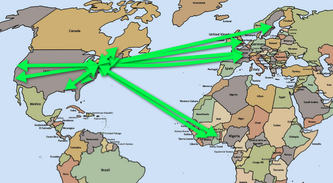
Students in Cleveland reaching out to the world
Mike and I have tried to take on the global classroom head on. Over the last few years we have used skype, meeting.io, google hangouts and more to open a window from our rooms to experts far beyond Cleveland Ohio. We have visited, Paris, Stockholm, London, West Africa, and many many parts of the United States.
Last year, we made a decision it was time to really send our students out into the real world. Several students, during the Middle Ages Webquest, came up with questions on topics neither Mike or I could answer; so we turned to our PLN. We tweeted, sent emails on listeservs and within two days, had 20 PhD's around the world who were willing to be interviewed by our students for the online book. The rest of this post will explain one of these interviews (iMovie below) and the challenges we faced.
Two students became deeply engaged in Quest 10 of the Middle Ages WebQuest on the Black Death and the end of the MIddle Ages. In their independent work, they found several references to the Decameron by Giovanni Boccaccio (1353). Now, I know of the Decameron and I might have read parts of it years ago, but I don't really know about it. Regardless of what I knew or didn't know, my students still wanted answers. They were curious. As their teacher, it is my job to guide them towards greater understanding and to encourage their curiosity. They had finished the quest before others, so I turned them lose on finding out more. They created a GoogleDoc, found online copies of the text and began to read and share insights and questions they had with me. I was quickly getting lost in their summaries and questions; with no idea what to tell them. I could guess. Or try and provide educated ideas on what they wanted to know, but I did not know and did not have time to do the required research myself. So, I tweeted....
Last year, we made a decision it was time to really send our students out into the real world. Several students, during the Middle Ages Webquest, came up with questions on topics neither Mike or I could answer; so we turned to our PLN. We tweeted, sent emails on listeservs and within two days, had 20 PhD's around the world who were willing to be interviewed by our students for the online book. The rest of this post will explain one of these interviews (iMovie below) and the challenges we faced.
Two students became deeply engaged in Quest 10 of the Middle Ages WebQuest on the Black Death and the end of the MIddle Ages. In their independent work, they found several references to the Decameron by Giovanni Boccaccio (1353). Now, I know of the Decameron and I might have read parts of it years ago, but I don't really know about it. Regardless of what I knew or didn't know, my students still wanted answers. They were curious. As their teacher, it is my job to guide them towards greater understanding and to encourage their curiosity. They had finished the quest before others, so I turned them lose on finding out more. They created a GoogleDoc, found online copies of the text and began to read and share insights and questions they had with me. I was quickly getting lost in their summaries and questions; with no idea what to tell them. I could guess. Or try and provide educated ideas on what they wanted to know, but I did not know and did not have time to do the required research myself. So, I tweeted....
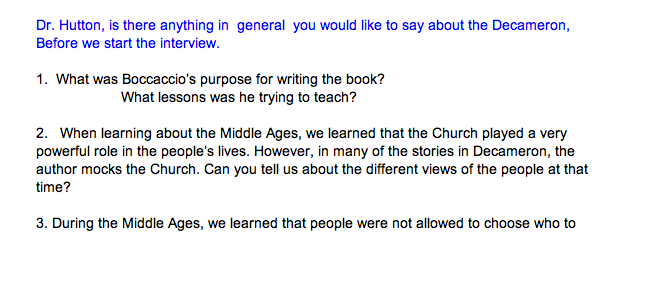
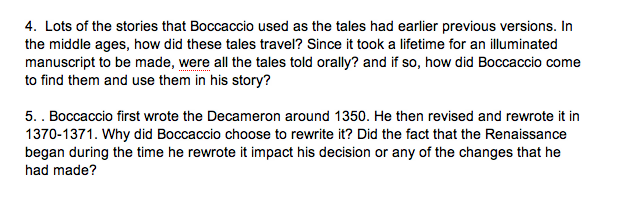

In steps Dr. Hutton, from University of California Davis. She is an expert on the medieval ages (PhD in medieval history), author about medieval times, and teaches about the Decameron. She agreed to be interviewed by the student via skype. It took several weeks and two attempts, but the final product is below. What an experience for these students. At 12 they are interviewing a world expert, 3000 miles away and captured that experience forever. They raised the bar for kids this year. What a LEGACY to leave behind. Truly digital footprints worth following.
Problems did arise: First, we had two PhD's who wanted to do the interviews, but did not have skype or know how to use it. I did arrange --long distance-- to have someone set him up with skype and be with him during the interview. We also had a major problem with our interviews in West Africa. We had images, but they could not send images back...so we ended up with only a PODCAST interview. Another problem, was setting up times. California is a few hours behind us, and West Africa a few hours ahead of us. Thankfully, individuals were able to find time in their schedules (some at 8:00 pm at night) so our students could interview them during school. We also, had to find somewhere for the whole class to go during interviews. We could not have 23 kids (12-13 years old) sit in silence for 40 minutes while we recorded. Other people in the building gave a helping hand:) thanks!!!
We also experienced two problems with Dr. Hutton. She was in her office in Davis, CA and we in Ohio, but I thought I hit record on the screencapture software (ISHOUWU--cost for this other free example to come later.), but at the end of a 40 minute interview, my "old" computer had frozen and only the first three minutes had recorded. Dr. Hutton, a great person, offer to do it again the same time on the next day....THANKS. It worked. The second problem can be seen in the film...a fuzzy side to the skpye window. The students were upset with the "quality" of the filming, but I explained to them the quality was the clearly outstanding...It's not about the image, but the thought and work that went into the process. They excelled.
Overall, it was pretty simple to get 20 plus PhD's that were willing to be interviewed by our students. We plan this year to get back in touch with a few of them we did not get a chance to interview last year, so we can add to our collection and hope to find more willing to join in the fun. If you know anyone willing to help, shot Mike or I an email with contact information.
Comment and suggestions are always welcome.
Cheers, Garth
We also experienced two problems with Dr. Hutton. She was in her office in Davis, CA and we in Ohio, but I thought I hit record on the screencapture software (ISHOUWU--cost for this other free example to come later.), but at the end of a 40 minute interview, my "old" computer had frozen and only the first three minutes had recorded. Dr. Hutton, a great person, offer to do it again the same time on the next day....THANKS. It worked. The second problem can be seen in the film...a fuzzy side to the skpye window. The students were upset with the "quality" of the filming, but I explained to them the quality was the clearly outstanding...It's not about the image, but the thought and work that went into the process. They excelled.
Overall, it was pretty simple to get 20 plus PhD's that were willing to be interviewed by our students. We plan this year to get back in touch with a few of them we did not get a chance to interview last year, so we can add to our collection and hope to find more willing to join in the fun. If you know anyone willing to help, shot Mike or I an email with contact information.
Comment and suggestions are always welcome.
Cheers, Garth
 RSS Feed