21st Century Skills
 
Picture
So the answer to the Homework quote is 1890.  The email I received from Jen is below.  Thanks for sending this my way Jen and to the few that guessed... Good work.

From Jen:
In the October 2010 Scientific American http://www.scientificamerican.com/article.cfm?id=50-100-150-oct-2010 they were reflecting on articles written 50, 100, and 150 years ago.  One article mentioned is one that I think that Mike would especially like.  Believe it or not, this is the article from the October 1890 edition!  Here it is:   Against Homework
“A child who has been boxed up six hours in school might spend the next four hours in study, but it is impossible to develop the child’s intellect in this way. The laws of nature are inexorable. By dint of great and painful labor, the child may succeed in repeating a lot of words, like a parrot, but, with the power of its brain all exhausted, it is out of the question for it to really master and comprehend its lessons. The effect of the system is to enfeeble the intellect even more than the body. We never see a little girl staggering home under a load of books, or knitting her brow over them at eight o’clock in the evening, without wondering that our citizens do not arm themselves at once with carving knives, pokers, clubs, paving stones or any weapons at hand, and chase out the managers of our common schools, as they would wild beasts that were devouring their children.”

So 150 years ago in a formal U.S. education system that started about 170 years ago, many were already noticing that the model was not working, yet many of us still to this day do not want to stray from the broken 170 year model.  In my previous business career, I was required to react to ineffective strategies or attempts immediately in order to ensure my company was making as much money as possible, yet the education system still cannot be figured out!

 
 
Picture
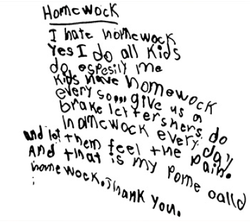
Mike and I have been talking a great deal about homework.  What is the purpose?  Why do we give it? How does it help students learn?  Is it needed?  Does it motivate? How does it encourage thought?  Do we still need it?  Mike has taken Homework off the table at his school, I have greatly reduced the homework given and the type of homework has changed as well.  I will talk more about that in the next post.  Today I want to get us all thinking, before I dig to deep into this idea...so stay tuned.  But for now...

Many articles, journals and publications (do a google scholar search, or check out Time) have been done  about homework and how it impacts learning.  Take a look at this research from A Time Article:
• According to a 2004 national survey of 2,900 American children conducted by the University of Michigan, the amount of time spent on homework is up 51% since 1981.
• Most of that increase reflects bigger loads for little kids. An academic study found that whereas students ages 6 to 8 did an average of 52 min. of homework a week in 1981, they were toiling 128 min. weekly by 1997. And that's before No Child Left Behind kicked in.
• The onslaught comes despite the fact that an exhaustive review by the nation's top homework scholar, Duke University's Harris Cooper, concluded that homework does not measurably improve academic achievement for kids in grade school. That's right: all the sweat and tears do not make Johnny a better reader or mathematician.
• Too much homework brings diminishing returns. Cooper's analysis of dozens of studies found that kids who do some homework in middle and high school score somewhat better on standardized tests, but doing more than 60 to 90 min. a night in middle school and more than 2 hr. in high school is associated with, gulp, lower scores.
• Teachers in many of the nations that outperform the U.S. on student achievement tests--such as Japan, Denmark and the Czech Republic--tend to assign less homework than American teachers, but instructors in low-scoring countries like Greece, Thailand and Iran tend to pile it on.   Read more: http://www.time.com/time/magazine/article/0,9171,1376208,00.html#ixzz1Dc2IhKIJ

Now, today I got an email from a friend.  She shared with me a quote.  I want you to read this quote and make a comment of when you think this was written.  Over the weekend, I will post the link and year...DON'T GOOGLE IT....That Is Cheating.

“A child who has been boxed up six hours in school might spend the next four hours in study, but it is impossible to develop the child’s intellect in this way. The laws of nature are inexorable. By dint of great and painful labor, the child may succeed in repeating a lot of words, like a parrot, but, with the power of its brain all exhausted, it is out of the question for it to really master and comprehend its lessons. The effect of the system is to enfeeble the intellect even more than the body. We never see a little girl staggering home under a load of books, or knitting her brow over them at eight o’clock in the evening, without wondering that our citizens do not arm themselves at once with carving knives, pokers, clubs, paving stones or any weapons at hand, and chase out the managers of our common schools, as they would wild beasts that were devouring their children.”

My next post, I plan to tie this together with 21st Century learning and Right Brain Thinking. 


Picture
Jenna Daugherty is our guest blogger today.  She is the intervention specialist that I (and the students) are lucky enough to work with everyday.  Jenna is a passionate professional that shares Garth and my desire for reflective teaching, change, and taking risks.  She came up with a great lesson after we reflected about starting a "no homework" policy.  Students were engaged in learning!  It made me proud to be a teacher today; a shining moment in my career.  I can only be as good as those with which I collaborate.  Luckily I keep great company in Garth and Jenna.  Thank you for making me better at what I do...

Yesterday, in class, we wanted to get the students thinking about the rest of the year and what things relating to world history they wanted to learn more about.  Instead of coming into class with a pre-generated detailed lesson plan and syllabus on what we were going to teach, what students would be learning and how they would learn it; we gave the reigns to the students. We want students to take ownership of the class and the content we discuss. The goal is to create students that are invested in the discussion, assignments and projects they do within the class.  Students feel empowered to control their learning destiny.  It wasn’t just lip service either; Mike and I are going to make the curriculum fit what students want to study. 

The past couple of weeks we’ve discussed culture and introduced different aspects, or parts, of culture. We started this with a project Garth created called “What was 7th Grade like?”.  Students look into their own lives and family history to uncover culture/cultural diffusion from the recent past; the decade their parent(s) were in 7th grade.  We incorporated higher level questioning skills, interview and research skills with students through this project. Now that students had an idea of what makes “culture”, we introduced the foundation of the class, which is the concept of civilization. 

We posed a question: “what characteristics do you think a group of people have to possess to be considered a civilization?”  Having a list of characteristics for civilizations, we told the students to think… Think about what you want to learn appropriate to a class entitled “world history”.  That was their homework.  Not a worksheet.  No questions or short answers.  Simply to think about class outside of the school.  It is our first attempt at the new “no homework” policy in our class. 

So, today students came prepared to discuss and debate what they had thought about.  Many students came with their lists of questions (which was not required), and those that didn’t necessarily write those down, had a couple minutes to organize their thoughts on paper.

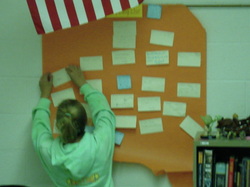
Around the classroom we hung large colored poster boards with the different characteristics of civilizations: geography, government, the arts, economy, religion, social structure and an “everything else” category. We gave each student post-it notes to write their best questions down, whether it was all 5 or just 1. It wasn’t the quantity that mattered; it was the quality.  After writing their questions on separate post-it notes, students stuck them to their desks.  They then had to rotate to a new seat somewhere else in the classroom and were given the task to take another student’s post-it notes and stick them onto the correct colored poster board around the classroom.

This lesson incorporated the different modalities of learning as the students discussed with each other their questions by means of think/pair/share (auditory), wrote down the questions and sorted them onto colored poster boards (visual), and had the opportunity to physically handle the post-it notes while walk around the room to find the right category (kinesthetic). 

Watching this in an inclusion setting with students identified with disabilities, it was impossible to distinguish between students of varying abilities.  Listening the student’s conversations, we heard tons of higher-level questioning as they asked each other questions and debated about certain areas.

...We are developing patient-learners who value quality not quantity


-Jenna