21st Century Skills
 
Picture
_Welcome administrators to the December 1, 2011 "21st century skills for transforming teaching and learning in the Social Studies" workshop.  Below you will find links to further explore the information we presented today.  This presentation will be a brief overview of the skills and work of our students.  

Direct Links:
Student-created Digital Textbook
Shared Classroom Blog

"...multimedia technologies, which use text, audio, video, graphics and animation to communicate information, offer today's teachers a mechanism to move from a 'linear' learning environment to a 'nonlinear' environment - one which offers users interactivity, control 
                                                      of progress, and choice in their construction of knowledge."
                                                                                      -Cuper and Lambert cited in Hanover Research Council 
                                                                                       Maintaining Competitiveness in the 21st Century, 2010

                                                 ...and so we will...

Presentation Links:
Creativity & Innovation
Collaboration  
Mastery Learning
Communication                   


"Schools and teachers must be challenged to use the tools and techniques of today,  not the ones of the past." 
                                                                   -Association for the Supervision and Curriculum Development, 2009. 



21st Century Skills Presentation

A 10 year vision to change teaching and learning

Student-created (12 year-olds) documentary of a teacher conference

21st Century Technology in one Word...


Picture
Welcome GCEDC members to the November 15th seminar concerning GoogleDocs and other valuable Web 2.0 tools to help enrich your teaching and inspire your students' learning.  Below this post is a survey created using GoogleDocs.  Please take a moment to answer each question.  Garth and I will show you just how easy it is to organize a survey/test and manage the answers/information collected from this type of interactive document.  You will also notice that we have include several Web 2.0 tools that we use in our 7th grade world history classroom to engage and inspire students to master curriculum and harness their creative-thinking potential. 
All of the tools below are FREE and linked to the homepage for each product.  After we discuss some of these tools we will give everyone a chance to look deeper at one, or a few of them.

Web 2.0 FREE tools:
Communication
    Skype
    Twitter
    Diigo
Blogs
    Weebly
    Wikispaces
    Blogger
Concept Mapping
    Bubbl.us
    Personal Brain
    Webspiration
Visualizers
    Voki
    GoAnimate
    Xtranormal
Word Clouds
    Wordle
    Tagxedo


Picture
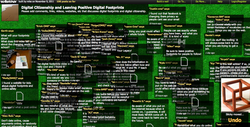
This week both Mike and I were teaching about leaving positive digital footprints.  We skpyed a few times and shared ideas between the schools with great discussions on this topic.  We set up a wallwasher page inside our blog for students to post ideas, links, comment, images and so on.  We thought a few kids would post.  However, over 110 posts total on the first day, not to mention 13 post on the blog.  

The work is embedded below, but after so long it will delete the work (click the pink "Post a sticky" to open full screen). But, you can see an image to the left after day one.  Great work by kids and they found some great information on digital footprints. 


Picture
Mike and I do the same project to start the year.  It is called, "What was 7th grade like?"  This project is based on kids learning a few skills: Interviewing, researching, creating essential questions, storytelling and building a documentary.    In essence, they become historians.  Over the years, I have collect about 750 of these documentaries and this is the first one a parent has given written permission to post.  I hope you enjoy it and I am sure this 13 year old would love to read your comment of her work.  

Pay close attention to the very end.  The last minute or so is very impressive.  


Picture
I just read the eulogy written and delivered by Mona Simpson at her brother, Steve Jobs’ funeral. The ironic thing is that I came across the eulogy looking back at the days Tweets via TweetDeck.  Okay, so that is not so ironic, the real ironic part is that before I read the eulogy I read a Gallop Poll conducted over the 4 business quarters of 2010.  According to the poll, above 50% of American workers are disengaged with their job.  That means 1 out of every 2 people you see on the street are not passionate about what they create, change, influence on a daily basis.  Around Halloween people talk about zombies, but in actuality most people are just making it through the day emotionless with no clear path.  It was disheartening to read such a statistic, so I imagine the emotional impact of reading such an amazing eulogy right afterwards was heightened.  Steve’s sister is a writer and a professor.  Her words are eloquent and her love for her brother shows in every metaphor and anecdote. 

So often in the last few months the idea of inspiration and love and leading life using emotions has resonated to me: everywhere from national conferences to local workshops and now in the tender words of a sister whom lost a brother.  The arts and the humanities have, for far to long, been under-valued to science and math.  Taylor Mali speaks about seeing God and beauty in Math, “How can you teach math without speaking of God…”.  I received a wonderful email from a parent today (coincidence at this juncture in my life?) that thanked me “for all I do to engage [my] child in your class”.  I emailed back that I really want to go beyond engagement and inspire people.   

The talk about common assessment and standardization and cutting physical education and art classes makes me sick.  People are so worried to let education change for the better, but those same people are very quick to cut the things that are currently making education so great.  The National Middle School Association released their “This We Believe” statement.  It is a collection of attributes and characteristics considered “Keys” to education today’s youth.  2 of the 16 characteristics concern curriculum and assessment.  That’s 12.5% of a child’s total education.14 characteristics and 4 essential attributes speak of educating the rest of the child...the part to the left and under the focus of math and science.  The brain has two hemispheres and they are connected for a reason.  We have arms and legs and feet and feelings and stomachs and hearts and they are valuable learning and living tools.

As I see my philosophical beliefs flourishing, a personal renaissance that I am lucky enough to share with Garth, and I wonder where I can find empathy.  It rarely exists in teachers and is even more rare in administrators.  I wonder why my life has brought me to this point? I read the autobiographies of people that are creative and brave; Neil Peart, Russell Means, Jack Kerouac, Steve Jobs.  I wonder if they ever truly find fulfillment in what they do, or if it is a constant battle to impact the world. 

It isn’t about success and failure.  It isn’t about being remembered.  It isn’t about awards.  It isn’t about being the best.  It isn’t about being the favorite.  It’s about changing the world.  Nothing more and never, never anything less.