 So here we are at a 1-to-1 laptop school. My 12-year-old students are so excited about the project we have been working on; they are interviewing their parents, grandparents, or anyone over 30 to try and answer the essential questions: (1) What does an historian do and how do they do it? (2) How has life and culture changed in American since your interviewee was in 7th Grade? Students get to play history detective. They pick someone to interview and then study the time period that the person was in seventh grade. We spent time brainstorming topics to ask about, writing open ended questions and several days researching national and international events that took place during the time their interviewee was in middle school. In the end, they usually build an iMovie that explains their parents (interviewee’s) middle school experience while addressing the essential questions. In years past, we have also use this project to teach iMovie in a failure free way. Over the years this has produced 100’s of interviews with primary images from the time period that discuss the changes in the world. Students get to see first hand just how rapidly culture changes and spreads. I thought that this year would be no different. Just like in years past, we have done the brainstorming, written the questions, interviewed the people and researched the events. Finally, the day has arrived that we devote to learning how to use iMovie to complete this project. The students finally get to take all of their puzzle pieces and place them together in a digital format to share with classmates and their family. The media specialist and myself planned what we would teach about iMovie a week in advance. The day came and we began to teach students iMovie. After ten minutes or so we began to notice students starring at us as if we had lobsters crawling out of our ears. They were not getting it, what was rather simple for the previous years students, seemed a daunting task for this year’s students.
It seems a small glitch had occurred. We were teaching on iMovie ‘08 version 7.1.4., the version that all of the faculty computers include. This year students received new laptops with iMovie ‘09 version 8.0.6. That means everything we just showed the students to do is completely wrong. Not only were students unaware of how to use iMovie, we just spent 10 minutes showing them the wrong thing to do! Ok, what fix do we make? We will teach enhanced podcasting with links in GarageBand. GarageBand is a program we use regularly so teaching it at this point in the year would still work well. Unfortunately, you can guess… faculty have the ’08 version and students have ‘09. But wait, it gets worse. The sixth graders have the older GarageBand and iMovie HD, so the teachers in the building don’t have a copy of the software that any student in our building has access to! That also means that the sixth grade is using a completely different version of software than the other students in the building. It is hard to teacher with comments like: “it won’t look like this, and you don’t click here, but click that.” And “well, I am not sure as I have never used that software or have access to it.” Teaches were not made aware of this issue, nor were we given any training on the new software. I felt frustrated and stupid. It will make for an interesting week.
 Jenna Daugherty is our guest blogger today. She is the intervention specialist that I (and the students) are lucky enough to work with everyday. Jenna is a passionate professional that shares Garth and my desire for reflective teaching, change, and taking risks. She came up with a great lesson after we reflected about starting a "no homework" policy. Students were engaged in learning! It made me proud to be a teacher today; a shining moment in my career. I can only be as good as those with which I collaborate. Luckily I keep great company in Garth and Jenna. Thank you for making me better at what I do...
Yesterday, in class, we wanted to get the students thinking about the rest of the year and what things relating to world history they wanted to learn more about. Instead of coming into class with a pre-generated detailed lesson plan and syllabus on what we were going to teach, what students would be learning and how they would learn it; we gave the reigns to the students. We want students to take ownership of the class and the content we discuss. The goal is to create students that are invested in the discussion, assignments and projects they do within the class. Students feel empowered to control their learning destiny. It wasn’t just lip service either; Mike and I are going to make the curriculum fit what students want to study.
The past couple of weeks we’ve discussed culture and introduced different aspects, or parts, of culture. We started this with a project Garth created called “What was 7th Grade like?”. Students look into their own lives and family history to uncover culture/cultural diffusion from the recent past; the decade their parent(s) were in 7th grade. We incorporated higher level questioning skills, interview and research skills with students through this project. Now that students had an idea of what makes “culture”, we introduced the foundation of the class, which is the concept of civilization.
We posed a question: “what characteristics do you think a group of people have to possess to be considered a civilization?” Having a list of characteristics for civilizations, we told the students to think… Think about what you want to learn appropriate to a class entitled “world history”. That was their homework. Not a worksheet. No questions or short answers. Simply to think about class outside of the school. It is our first attempt at the new “no homework” policy in our class.
So, today students came prepared to discuss and debate what they had thought about. Many students came with their lists of questions (which was not required), and those that didn’t necessarily write those down, had a couple minutes to organize their thoughts on paper.
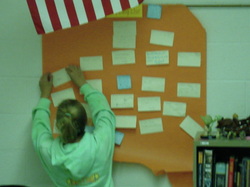
Around the classroom we hung large colored poster boards with the different characteristics of civilizations: geography, government, the arts, economy, religion, social structure and an “everything else” category. We gave each student post-it notes to write their best questions down, whether it was all 5 or just 1. It wasn’t the quantity that mattered; it was the quality. After writing their questions on separate post-it notes, students stuck them to their desks. They then had to rotate to a new seat somewhere else in the classroom and were given the task to take another student’s post-it notes and stick them onto the correct colored poster board around the classroom.
This lesson incorporated the different modalities of learning as the students discussed with each other their questions by means of think/pair/share (auditory), wrote down the questions and sorted them onto colored poster boards (visual), and had the opportunity to physically handle the post-it notes while walk around the room to find the right category (kinesthetic).
Watching this in an inclusion setting with students identified with disabilities, it was impossible to distinguish between students of varying abilities. Listening the student’s conversations, we heard tons of higher-level questioning as they asked each other questions and debated about certain areas.
...We are developing patient-learners who value quality not quantity
-Jenna
 At the end of the day, the whole reason we integrate technology is to create students that create the questions, not just the answers. Recently I discovered (through TEDtalks tweet) an amazing high school math teacher named Dan Meyer, click here for his blog. Dan presented at the TED conference and talked about re-inventing how math is taught. basically, Dan doesn't give homework, hates textbooks, and wants to create "patient problem-solvers". His presentation is the video below this blog post. I love the term "patient problem-solver". To me it evokes imagery of students using the scientific method in a social studies classroom. Students observe something happening in the world around them, create a hypothesis of why it is happening, then formulate questions to answer using historical resources. How great would it be if students applied patience, collaboration and technology to understand why the world works. Students could skype students around the world, or professors from major universities specializing in particular areas of history, scour the internet for historians blogs and primary resources, then test their data against their hypothesis. Maybe they were right, maybe they were wrong. Either way students have complete ownership of this academic journey. From observation, to asking the question, to solving the question. Students can take days, or weeks to solve one major question; and along the way....accidental learning will take place. Students will be exposed to research tangents that pull in information, create connections with others, and hone their critical thinking skills. All of this is possible if you model patience with your students. Dan Meyer talks about how textbooks create problems that mirror contemporary sit-coms. Everything can be solved in a 1/2 hour. Only problem is that the world doesn't work that way. As Dan says, have you ever seen a problem worth solving that can be accomplished in a 1/2 hour?" (I'm paraphrasing here) Take a second and watch his presentation and then please leave a comment expressing your opinions. Just think, maybe answering 4 or 5 big questions in an entire school year will provide a better education than weekly assessments and a yearly 40 question standardized test. -Mike
 Here is an article that I wrote, Garth helped edit, for Phonedog.com. Phonedog is one of the leaders for information concerning cell phones and mobile technology. I work in a middle school full of kids in sixth through eighth grades. Just a few years ago cell phones were seen as the newest teenage addiction, a drug that had to be repressed and condemned by schools. It’s not really all that bad, though. I am willing to wager my Android smartphone that parents are paying for students’ cell phones. It stands to reason then, that parents are okay with their kids using these devices. So parents are okay with cell phone use, the students are okay with cell phone use, yet schools have adopted zero tolerance policies. The question of how to provide students with technology plagues the majority of school districts. Rising costs and disappearing school funding makes it difficult to provide necessities like chairs and chalkboards, let alone laptops and smartboards. Challenging obstacles require creative thinking by schools; the same creative thinking that we want from our students. Schools need to realize that many students already have all the technology they need, right in their pockets and lockers. Most statistics agree that upwards of 80% of teenagers have cell phones. These kids are not just making calls, they are texting, checking email, updating FaceBook accounts and Tweeting. They are making social connections, sharing information, collaborating, planning and researching. Schools are becoming more flexible with cell phone usage policies, but it is a slow process. Our school policy is that cell phones must be kept in lockers and turned off during school hours. Yet, kids text during lunch, in bathrooms and even during class. The invention of “skinny jeans” makes it even easier to see students carrying their cell phones through the halls. As a teacher I have a choice: become cell phone Gestapo, scanning pockets and Uggs for phones, ignore the problem entirely, or turn the problem into an opportunity. This year I am inviting students to use their cell phones to leave a positive digital footprint in their wake. I want students to embrace technology and learn skills that will help them throughout their lives. I want students to communicate with me and with other students. I want students thinking about history (which I teach) when they are at home watching television, eating dinner or walking around the city. Kids need to develop an empathetic view of the world. They need to think critically about why things happen, what influences their choices and how they can positively impact on the future. This year my students will blog, Skype with their peers at another middle school almost forty miles away, create Delicious accounts and learn to tag. This year’s students will work on a digital textbook that my students last year collaborated on with another school. My goal this year is to use the technology that students already possess. I want my students to use their cell phones to learn, collaborate and create knowledge. I will be teaching in tandem with Garth Holman, a colleague and friend in a school district some forty miles down the road from us. Everything I mentioned that I’ll be doing, he’ll also be doing - it will be happening in two schools, between two heterogeneous groups of students. Using cell phones in an educationally appropriate way is difficult. My district is not going change its cell phone policies based on my beliefs alone. This year’s cell phone use will hopefully give me concrete examples of positive cell phone use that I might use to help enact policy changes in the future. For now I will ask my students to use their phones for class participation – homework – beyond the forty minutes I have with them each school day. Students using websites like Wiffitti and Flickr will engage in learning and have active roles in shaping their experience in my class. For those of you unfamiliar with Wiffitti, you may have used it without even knowing. Wiffitti allows you to create a “wall” where people can post messages. Each wall is assigned an SMS number and short code used to post texts; stadiums and television shows have used this technoology for years. Garth and I have a shared page set up where we can post a question and have all 230 of our students respond and engage with each other in a digital environment. Then we can project our virtual wall on our real classroom walls for discussions, or even discussions between our two classrooms via Skype. We are also going to post Twitter feeds on our blog and give our students the opportunity to “follow” experts via their cell phones and computers. This will enable students to see, hear and learn from real historians, archaeologists and scientists who post information and questions in real-time. What’s nice about Twitter is that students without mobile data plans can still use their home computers to engage in the world around them. One last idea to consider concerning the use of cell phones in education: We want students to understand that history and geography are all around them, at all times. Students are going to have the ability to text pictures to our class Flickr account, assemble the more significant photos into a Google Earth layer, and use Mosaickr to turn our collected images into giant mosaic prints. It’s been said a hundred times: Today’s students learn differently than those of just 10 years ago. Technology is not a choice, it’s a reality that has changed the world in which we all live. School needs to be organic, not linear: It is not about testing and standard, but about nurturing creative question-askers, collaborators, and thinkers. We need students who can use cell phones, Twitter accounts, and the rest of today and tomorrow’s tech to collaborate with field experts, classroom teachers and one other. I challenge you to open your classroom to the world this year. Adapt, create, and take a risk or two.
|