21st Century Skills
 
Picture
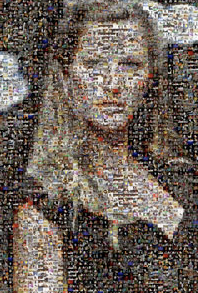
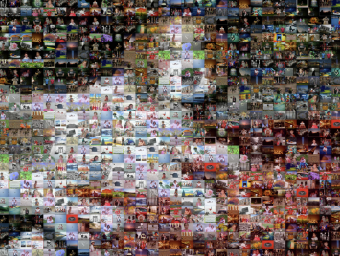
My dog, Woody. Made with 275 images
Mosaickr.com is a mosaic maker.  You use flickr photos to create mosaics.  I plan to use this site this  year for open house.  On the first day of school, I will take photos of each student and upload them to my class flickr page.  Then each day I will snap a few more photos of students working, so that by open house I have a few hundred images.  Then I plan to use  our school logo to create a mosaic for my door.

The examples below are from the Mosaickr.com site. You will need to have a flickr account, but you do not need a lot of photos uploaded.  You can create these mosaics using open source images others have taken right on flickr (Cleveland, Ohio has over 600,000 images).  You can get the Small mosaic for free and it downloads directly to your computer.  You can also pay a fee and get much larger images.  The downloads are fine for most application in school. 

Classroom Ideas:
1.  Historical figures with images from their life or geography mosaics
2.  LA: What book are you reading? Images of that subject
3.  Science: Ocean Theme, Weather, Animals, and more
4.  Math: Great architecture of skyscrapers or buildings (even my hometown of 45,000 has 29 images of buildings,  Newark Ohio)
5.  Art: Famous Artist with their work
6.  What would you add?


Picture
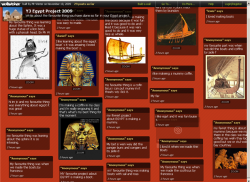
Wallwisher is a great new website that allows users to create virtual sticky notes and post them to a wall.  As  I read through the companies FAQ and "about us" pages, I learned 2 things: they have a great sense of humor and the walls you can create through their website can be an extremely useful communication tool for schools.  Students do not need to sign up or register to use Wallwisher, and your walls can be made private.

Some possible uses for Wallwisher in the classroom?  I could see this as a great communication device where students can post questions, either about homework or important concepts from class.  Other students can answer these questions, or debate topics by adding their own sticky notes.  Sticky notes can be moved around so you could organize different areas of your wall for different ideas.  Maybe you want to see if people would rather take a test on Thursday or Friday?  Just have students put their name on a sticky note and slap it up under the day they like.

As technology presses forward and we, as teachers adapt to these changes, free websites like Wallwisher are providing unique experiences that make virtual communication more interesting and manageable.  If you take a step back, Wallwisher is basically a twitter post/blog page.  The difference is interface; you can move and rearrange your posts (sticky notes) and their is a bit more interactiveness to the communication experience.  Try it today in your classroom and set up a homework help wall.

-Mike


Websites mentioned in this show:
NorthWest Ohio Educational Technology Conference--watch the live webshow from the conference on Aug 10 and 11.
State Standard Student Created Textbook, In wikispaces
Wiffiti Send texts to your classroom computer
Wallwisher add post-it notes for homework help?
Mosaickr: Cool for Open House images.
At the end we shared how we start the first day of school.  What do you do?
And who knows, we could have missed some.  Garth and Mike
 
 
Picture
Our webshow was canceled tonight...Mike explains in our podcast.  However, the guest was ready, so the show went on via skype and GarageBand.  The topic for tonight was Social Networking in the State of Ohio.  Abby created a Ning site called "Ohio Educational Technology Network" for teachers in Ohio to share ideas, lessons, podcasts, the list goes on and on.  Tonight we discussed the future of this site and the possible directions the site will take.  Please visit the site at www.oetn.org.

Abby Thaker's bio is below.  Enjoy the podcast.

Abby Thaker manages Professional Development for Smart Solutions K-12 (www.ssik12.com) where she works with school districts throughout Ohio to support effective classroom technology integration.  Prior to joining Smart Solutions Abby taught elementary school, first as a Teach for America corps
member in North Carolina, and later at a charter school in downtown Cleveland.  Abby has served as an Ohio Education Policy Fellow through the Institute for Educational Leadership and Cleveland State University, and 21st Century Learning Fellow with the Powerful Learning Practice.


Picture
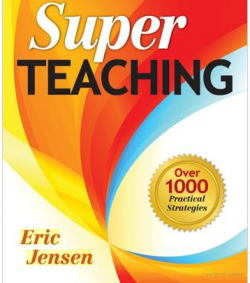
Eric Jensen, wrote a book called Super Teaching (to view in google books)  and published it in 1995.  It was and is an interesting read.  I read it five or six years ago while taking a graduate course online from the University of Akron.  I pulled it out tonight to take a look at the section on music...but I got side tracked and re-read "The Game Has Changed".  That is chapter one.  Under the title, "The Information Age" he points out that the "The gap between what's know and what's implemented in schools is wide...enormous Lag time before implementation. In fact, the lag time for innovation within the system is usually 5-10 years for pilot programs, and 10 to 25 years for widespread implementation [in school]."  

Well, 1995 to 2010.  If I added right that is 15 years, correct?  Mike and I talked about doing this blog much sooner, but kids, work and life got in the way.  I read blog after blog about how teachers are using technology and engaging kids in new and innovative ways.  I often get overwhelmed about what is on the web and how teachers are using technology to engage kids.  Then I look at my local area and realize that is not the world for many  students in today's public schools.  My own kids, 10, 8, 5 do not use technology in school in a ubiquitous way.  They "sometimes" search the web, play an educational game or maybe get some free time to "play" on the computer.  Their school has not implemented technology in a widespread manner.  I have two major cities within 30 miles of my house (Akron and Cleveland) and I believe (do not know this for sure), that technology has not been implemented widespread in these districts.   That is over 75,000 kids.  They each have magnet schools that focus on technology (STEM Schools--Akron Beacon Journal article on STEM middle school: one, two and Newsweek article on the school in Akron: three ), but in the rest of the schools I am not sure how widespread technology use is.  We are planning webshows with administration and teachers at both districts to address some of these issues and to better understand what is going on in Cleveland and Akron(time and date TBA).

As a teacher of middle school students and professor at the university, I see both worlds: kids at work in public schools and graduate students in the field.  I understand the financial difficulty districts are having, but I also understand the need for investments in the future of this country.  As Eric Jensen pointed out, as a society a great deal of change should be coming in the education field in the next 10 years.  I just hope it comes soon enough for my children

And for those of you blogging and using technology in your classroom or district keep leading the way for others to follow. 


Tonight we spoke with Linda LoGalbo, principal at Beachwood Middle School.  Her bio is below.  Mike and I would like to thank her for taking the time to talk with us. 


Linda LoGalbo has Bachelors of Science in Education from Bowling Green State University in Mathematics, Masters of Education from John Carroll University in Educational Administration, and currently is working on her Superintendent Licensure from Ashland University.  She taught mathematics at the high school level for 7 years and is about to begin her 10th year of middle school administration.   Under her direction, Beachwood Middle School has been named a National School to Watch by the National Forum to Accelerate Middle Grades.   Beachwood Middle School also successfully expanded the one to one laptop program to include grade six in 2007.
 
 
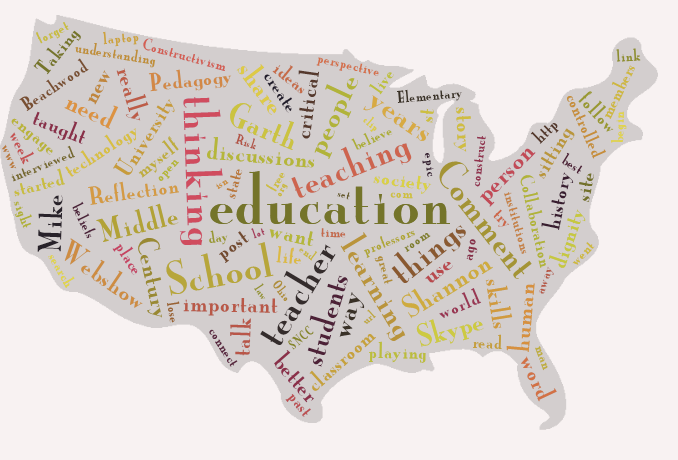
Garth shot me a link to this site this morning, and we were both so blown away by how cool it is, I just had to link it here.  Tagxedo is a word cloud generator that lets you copy/paste text, use url's, your twitter stream and more to create word clouds.  Why is this site more grawsome than Wordle?  At Tagxedo, you can easily change every characteristic possible: eliminate common words, change orientation, change colors AND you can have your word cloud appear in shapes.  The picture below is an example of a word cloud I created by entering the url to this blog.  Because its about education, I went with the cliche "apple" shape.  In the beta version, you can even upload your own images to use!!  Check this site out and think about ways to engage students with your curiculum!
 
 
A few nights ago I was riding home on the motorcycle and I had a nice long hour and-a-half ride to think about things.  It was completely freeway miles, so I got comfy in my alligator seat, crossed my arms and let my mind wander a bit…while paying attention to the road of course.  I started thinking about something that may be common sense and it may even be too obvious a thing to waste a blog post on, but Garth’s last post relates to what I was thinking.

A lot is being said these days about education and “how we educate”.  When I began in this profession three’ish years ago, I always called myself a teacher.  Somewhere along the way I started to call myself an educator.  I do not think that this was a conscious choice; rather the system assimilating me.  If I became an educator, then that means I am part of the “problem of education”.  It may seem like semantics, but I really started to think about how important the words we choose to define ourselves are. 

Teaching is as old as the human race.  Men taught their sons how to hunt; watch me, and then you do it.  Women taught their daughters how to sow a field; watch me, and then you do it.  Children taught each other games, man taught each other government and religion, so on and so forth.  Education though, is a relatively new event if you look at human history as a linear thing.  So I started thinking about if the two are the same thing or not; is a teacher the same as an educator?

I decided that they are two different ideas.  Education, from its inception and arguable through the present day, has been controlled by the rich and powerful.  The children of elite received an education to help their families remain elite.  Those that received education through religious institutions were taught to control (and remain controlled) by the institution in charge of the education.  It is the same today.  Ideas like No Child Left Behind, school funding, state standardized testing, etc all seem to favor those schools in more affluent areas.  In the past, students have escaped the oppression of formal education: Copernicus, Newton, Einstein, Zinn, and while more people are able to emerge as free-thinking spirits, it isn’t enough.

To these ends, I pledge to call myself teacher.  I want to teach students to think, to create, and to be independent.  One of my favorite poets said, “It isn’t enough to question authority, you have to talk to it too”.  Maybe the fix for education is to get rid of formal education, but keep teachers.  Teachers used to be a valued position in society; they were revered and often poor.  I could live my life a happy man as a teacher, and someday I hope to find a way to teach without the bounds and politics of education.

-Mike
 
 
A few weeks ago Mike and I interviewed Shannon Conley-Kurjian, a high school teacher for our webshow.  Shannon then sent a follow up blog to me (posted here). Shannon said this:  "I also believe that every person has an epic story that influences their perspective on things and no prescribed set of standards/curriculum will sit the same with any two people. So critical theory plays an important role in my classroom (http://www.freireproject.org/critical-pedagogy-and-teaching)" 

I was struck by this statement.  Not because it was a new idea to me, but in the way she phrased it.  The next day, I pulled Pedagogy of the Oppressed, By Paulo Freire off my bookshelf and started to read it again...it has been 10 years or so.  I read about 1/2 the book and keep thinking about something I had written in 1993 as a preface to my political science honors thesis.  It is copied and pasted below.  
 

Preface

           Often in life we forget about what is really important.  We focus on the material worth of an individual and forget about the worth of the individual.  We lose sight of what makes us all feel dignity and acceptance.  We find ourselves lost in work and unable to see the real people who make our work possible.  We take away a person's self-respect by our actions and our talk.  We unconsciously stab their heart with the knife of worthlessness.

            When Education loses sight of the "law of persons" it has lost all sight. It becomes a tool of the establishment in controlling and destroying people’s dreams and their dignity.  We lose confidence in ourselves and in all of society’s institutions and only the few hold on in search of a better tomorrow. 

            These are the underlying principles in the concept we call education;  tolerance, acceptance, moral understanding, critical thinking, questioning of society and our establishments,  truth, and human dignity.

            Often teachers forget this simple quote, "A master can tell you what to do. A teacher, though, awakens your own expectations."  Teachers, whether in universities, colleges, secondary or elementary schools, try to force youth down a path that leads to the "promised land" and yet that path only applies to a few.  We need to focus on opening our young minds to the global world, their opportunities and their own expectations with human dignity.

             I can only give one man's opinion as to what can be done in search of a better tomorrow for everyone.  We do face a global "crisis" in the thing we call education, but again what we really mean is in human dignity and the search for happiness in our complex cruel world.

            What I am saying in this preface is that too often we assume education is to be understood in a vacuum, I argue that this is not the correct way to see it.  We must approach it as education (not only in schools but in society) and in turn as the basis for human dignity and worthfulness in society.

            This paper is based on the underlining fact that education creates people and their beliefs and notions about individuals and society. This paper discusses a new way to think about the education of young people by using a new paradigm when teaching history called QUANTUM HISTORY that is based on the “law of persons” . This preface is intended to give you an insight into my personal thinking about educational beliefs that this paper is based on.


When Shannon reminded me of the beliefs and values I had held for years, it was a wake up call to reflect on the happenings occurring in my classroom.  I for one, thank Shannon for doing that. 
Let me know your feelings or ideas on the comments of Critical Theory in education, Cheers, Garth


Mike still drank a lot of coffee, but I did not look so mad.  I will get Todd's information and details up tomorrow.  Have a good night.