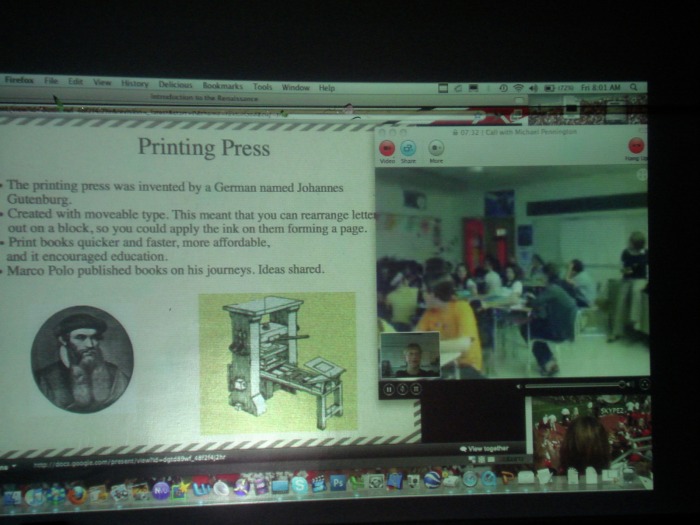
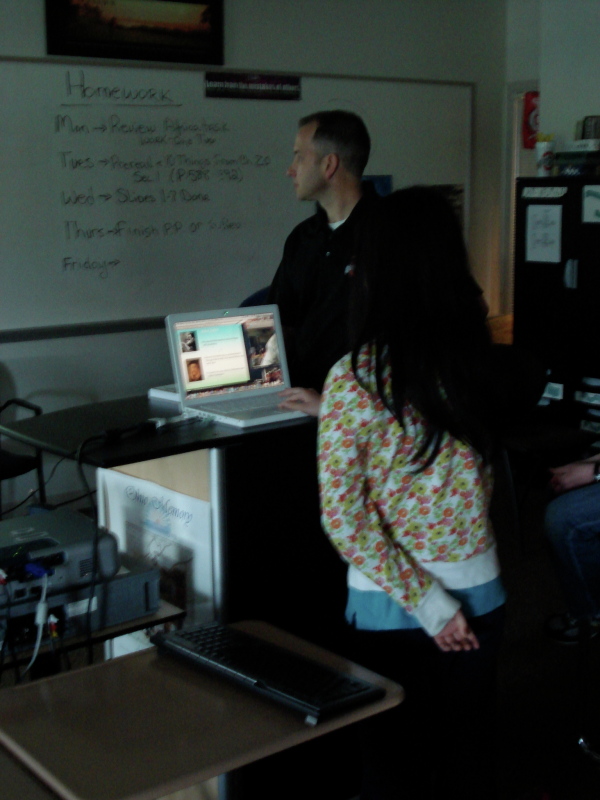
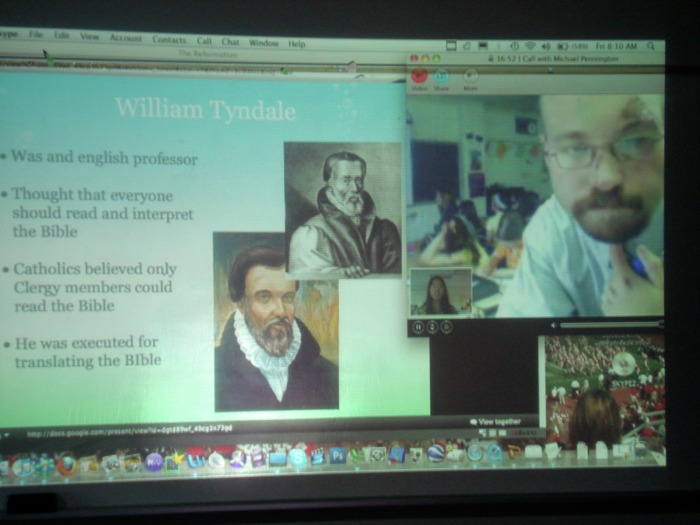
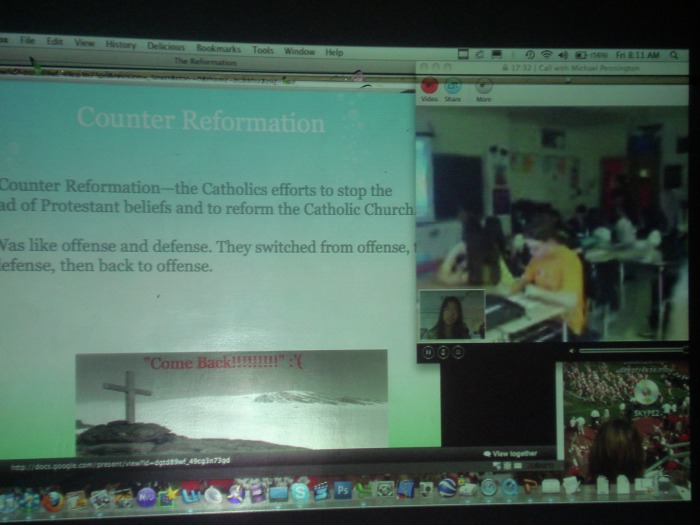
This morning several of my classes Skyped with Garth's students. Garth and I both spent time immediately after our Skypes talking about the positives and negatives of what just happen. While the Power Points my students presented were good, there was one tech issue and we also discussed student behavior.
Tech Issues:
I uploaded my students' Power Points to GoogleDocs last night so that Garth could open and project the student's work while they Skyped. Of course, the one Power Point I wanted to use would not upload. After discovering it was a corrupt file, I quickly uploaded a different group's PowerPoint and we pressed on. Technology is not perfect! While Garth and I both saw this as a problem, it was a great learning experience. Problems arise in the classroom all the time, and it is how you deal with those issues that determines the effectiveness of the lesson. Our tech issue was inconvenient, but it did not ruin the lesson.
The Giant Eagle Standard:
Last week one of my students, normally very passive, came into class very excited about something that happened to her the night before. She was at Giant Eagle with her mom and saw one of Garth's students in one of the isles. She walked up to this student and engaged her in conversation. I called Garth from the classroom and shared this story with him. Shortly after, the his student came into the room and shared the same story. These are two students from very different backgrounds, that would never have met if not for our Skype session, met each other outside of the classroom. Garth called it the Giant Eagle Standard. As teachers we need to create well rounded students that can collaborate and communicate with a variety of people. We inadvertently brought these two students together, as friends that felt comfortable enough to talk to each other in a setting outside of school!
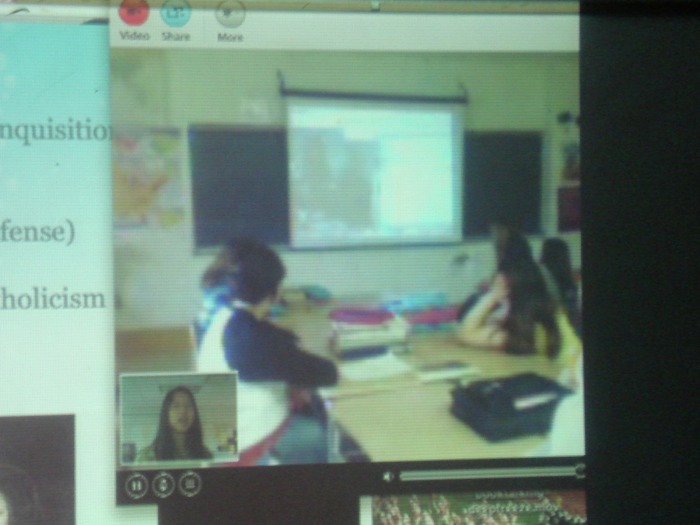
I taped one session with iShowU so that I could watch it later. We both were concerned about student's body language. On my end, I prepared my students for our Skype session by talking about the fact that a room full of adults and students at a different school are going to be able to see and hear your behavior. We had a discussion about representing our school well and how Skype is almost like having a guest speaker in the room. With all the discussion and prep, the minute the camera turned on, and Garth's class appeared on the screen; my students turned into 12 year old kids. Kids rushed to get on camera, sat on desks and made signs for each other. While this definitely took away from the content that Garth and I want the students to share; it also turned school into something more. These students let their guard down, they did not sit in perfect rows with hands folded, listening to another presentation. They interacted, they should excitement about the lesson and they acted like they would outside of the classroom. Often we talk about changing the learning environment to better reflect our students' lives, Our Skype session accomplished this goal. Students wanted to engage with each other. They wanted to be seen and heard. They were creative; three students made a sign for one of Mr. Holman's students that we have talked to several times and has become somewhat of a celebrity in my building. These students are creating social networks with other students. They are interacting the way middle school children interact. I want to reflect on this with my students on Monday. I want to discuss how to leave a positive digital footprint. Meaning, how can we take the social networking skills they have learned from using sites like MySpace and FaceBook and translate it to the classroom. Most of these students do not understand the consequences of their actions via the internet because the majority of schools and parents do not discuss it. Students need direction in learning anything, whether it be world history, studying skills, or the internet.
The newness and social qualities of Skype are a lot for students to handle, but at the end of the day it is a positive experience. Several students commented that they would much rather listen to other students teach them, rather then always listening to me. An adult in my district that witnessed a Skype session commented that he enjoyed watching students interact not only with curriculum, but with each other. He went on to say that too often school becomes some separate thing and students do not attach it with their lives. During the Skype session students internalized school and it became part of them. Our students created synergy.
-Mike
Tech Issues:
I uploaded my students' Power Points to GoogleDocs last night so that Garth could open and project the student's work while they Skyped. Of course, the one Power Point I wanted to use would not upload. After discovering it was a corrupt file, I quickly uploaded a different group's PowerPoint and we pressed on. Technology is not perfect! While Garth and I both saw this as a problem, it was a great learning experience. Problems arise in the classroom all the time, and it is how you deal with those issues that determines the effectiveness of the lesson. Our tech issue was inconvenient, but it did not ruin the lesson.
The Giant Eagle Standard:
Last week one of my students, normally very passive, came into class very excited about something that happened to her the night before. She was at Giant Eagle with her mom and saw one of Garth's students in one of the isles. She walked up to this student and engaged her in conversation. I called Garth from the classroom and shared this story with him. Shortly after, the his student came into the room and shared the same story. These are two students from very different backgrounds, that would never have met if not for our Skype session, met each other outside of the classroom. Garth called it the Giant Eagle Standard. As teachers we need to create well rounded students that can collaborate and communicate with a variety of people. We inadvertently brought these two students together, as friends that felt comfortable enough to talk to each other in a setting outside of school!
I taped one session with iShowU so that I could watch it later. We both were concerned about student's body language. On my end, I prepared my students for our Skype session by talking about the fact that a room full of adults and students at a different school are going to be able to see and hear your behavior. We had a discussion about representing our school well and how Skype is almost like having a guest speaker in the room. With all the discussion and prep, the minute the camera turned on, and Garth's class appeared on the screen; my students turned into 12 year old kids. Kids rushed to get on camera, sat on desks and made signs for each other. While this definitely took away from the content that Garth and I want the students to share; it also turned school into something more. These students let their guard down, they did not sit in perfect rows with hands folded, listening to another presentation. They interacted, they should excitement about the lesson and they acted like they would outside of the classroom. Often we talk about changing the learning environment to better reflect our students' lives, Our Skype session accomplished this goal. Students wanted to engage with each other. They wanted to be seen and heard. They were creative; three students made a sign for one of Mr. Holman's students that we have talked to several times and has become somewhat of a celebrity in my building. These students are creating social networks with other students. They are interacting the way middle school children interact. I want to reflect on this with my students on Monday. I want to discuss how to leave a positive digital footprint. Meaning, how can we take the social networking skills they have learned from using sites like MySpace and FaceBook and translate it to the classroom. Most of these students do not understand the consequences of their actions via the internet because the majority of schools and parents do not discuss it. Students need direction in learning anything, whether it be world history, studying skills, or the internet.
The newness and social qualities of Skype are a lot for students to handle, but at the end of the day it is a positive experience. Several students commented that they would much rather listen to other students teach them, rather then always listening to me. An adult in my district that witnessed a Skype session commented that he enjoyed watching students interact not only with curriculum, but with each other. He went on to say that too often school becomes some separate thing and students do not attach it with their lives. During the Skype session students internalized school and it became part of them. Our students created synergy.
-Mike
 RSS Feed