21st Century Skills
 
Picture
I had a chance to play a little bit with the Livescribe Digital Pen/Recorder.  Very impressive little gadget--Review of this product.    

The setting was a lecture from Marc Selverstone from the Miller Center at University of Virginia.  He was discussing the war in Vietnam and how the whitehousetapes.net could be used in the classroom.  During his lecture, Jim Luteran pulled out his Livescribe Digital pen.  He took notes on a special pad.  The camera on his pen transcribes his notes directly into his computer. 

Ok, so what?  By clicking on the notes on his computer screen it pulls up a digital voice file that the pen recorded and now he can listen again to the voice of Marc explaining the idea from the lecture that had taken place an hour before.   

The pen retails online or at Staples and Best buy for $149 for a 2 gig digital pen.  Just worth a look.   Garth
 
 
Last month, I began teaching feudalism and the Middle Ages of Europe.  I purposely started this new unit of study the week before Martin Luther King Jr. Day.  Going into the week of MLK Day, I gave a brief explanation of the feudal social classes.  Students worked in an extended "Think/Pair/Share exercise where they were responsible for creating social classes in the school, their community and the country.  Most students created groups based on popularity; as it was explained to me, "...popularity gives you power like money would have given you power in the Middle Ages".  The week of MLK day I used the Civil Rights Movement and the 1950s/1960s to talk about social classes and who had the power in America during these times.  As teachers often do, I assumed students had a good grasp on what life was like for African Americans during the 50s and 60s.  I was wrong.  We talked about the major events of the Civil Rights Movement and the beliefs of some of the key players.  I also showed a movie from the Teaching Tolerance program.  Like most lessons, the current day connections became more interesting and important than the historical connections.

Students had lots of questions about social inequality, enough so that I decided to spend more time talking about American history and doing history backwards (present to past).  I used a great website created by the Library of Congress called Voices From The Days of Slavery.  The site contains audio interviews of former slaves.  I played several narratives for the students and had them fill out sound analysis worksheets available from the National Archives (I changed it to fit my needs).  Students were captivated by these narratives.  It was the first time they had "heard" history from the people that lived it. 

The impact of listening to these narratives, compared to reading each narrative, was tremendous.  Students became engaged in why any society feels the need to create social inequality.  Several of my classes had great debates centered around the argument of whether social inequality is created by people, or naturally occurs because of human nature.

The point of all this...Students gained more depth of understanding of a topic in my class becuase of the use of technology.  The video and the audio narratives engaged students in conversations, compelled them to investigate further information independently, and allowed them to use critical thinking (higher-level) skills to understand the past using the present.  My students took time to think about the world and the enduring impact social classes and inequality has on the world around us.
Students are still making reference to the narratives and have even brought in articles from local newspapers with questions about the impact of social inequality on current events.  I may have moved on in class, but students are continuing to discuss a topic that is over a month old.
-Mike 
 
 
The Partnership for 21st Century skills outlines what it believes to be 21st Century skills today's schools need to be teaching. Ohio became part of this partnership in 2009.  The partnership talks about the traditional three R’s and the four C’s. The four C’s include the following:
1.     Critical thinking and problem solving
2.     Communication,
3.     Collaboration
4.     Creativity and innovation

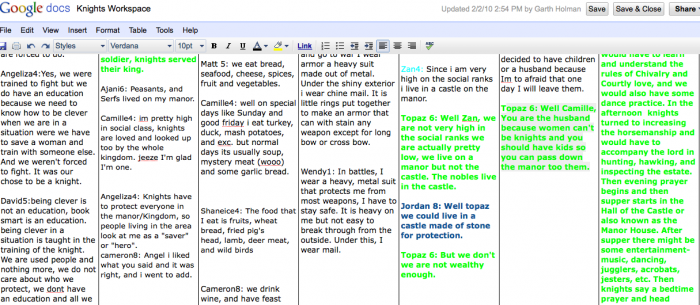
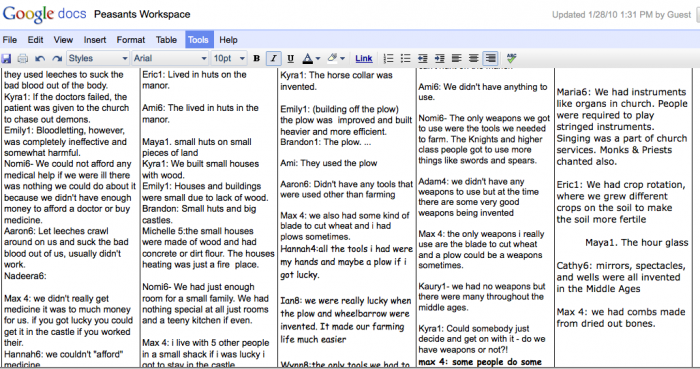
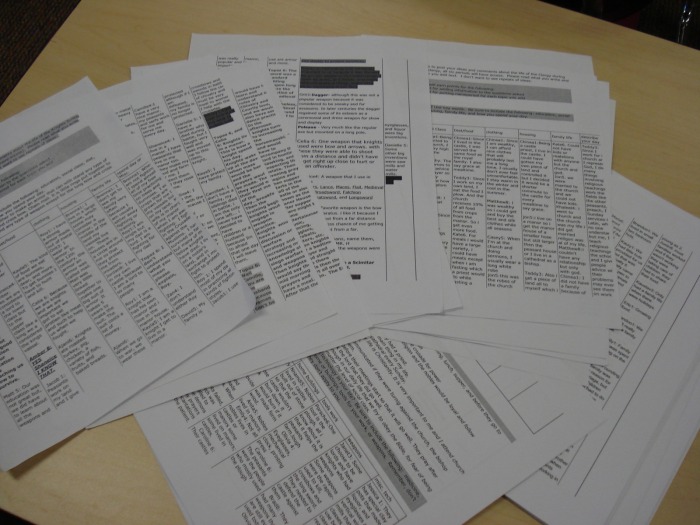
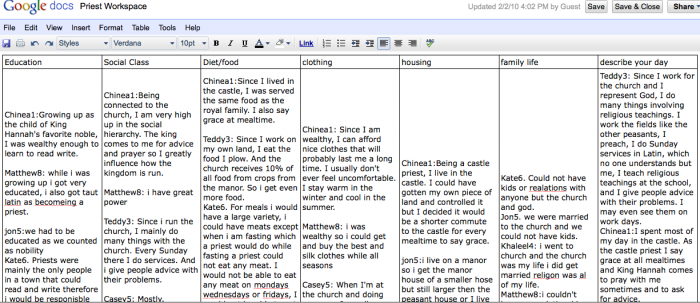
I would like to address the collaboration idea in this post.  For the last three weeks my students have been learning about the middle ages.  They learned the basics from a webquest, while viewing their learning from the perspective of one member of the social hierarchy during the middle ages.  While this webquest allowed student to explore different parts to the middle ages they did not have a great way to share what they were learning.  I wanted them to blog, but blogs were not “opened” for the students on our network.  So, I thought about what I could use.  I have used google docs for online testing (Read Mike’s Post on google doc testing), surveys and collaboration with other teachers, so I created workspaces for each group in the social hierarchy.  Students were able to share what they had learned with the kings, nobles, knights, clergy, or peasants from other classes in the middle school. Students had found had ideas, facts, stories that no one else had found and   with google docs collaboration with ever seventh grader in the school was possible and LIVE.  The images below give you an idea of what the final product looked like.  I did print out the documents and ended up with 51 pages of information.  I must say, almost all of it was good information…only one OMG, not bad for 109 12 year olds.   

Let my students tell you what they thought.   These are comments from their journals:
Connor:  I liked google docs because I got to learn new things and I was able to respond to questions my self or add on to other comments. The thing about google docs is you can openly discuss what interesting facts you know and its is very close to a silent classroom with no side conversations.  I liked how in google docs you could see what other people have written and branch off from that as opposed to a classroom where you could forget what that person said or what you were about to say.

Nadeera: Yes I did like the Google Docs because it was sort of like blogging. We got to type about how we felt as a certain persons perspective. It was fun to me and I learned a lot.

Caroline: Yes, I enjoyed the program because it gave us a chance to understand what other kids think about the same situation. It gave me new ideas and view points on the same topic and so many different thoughts about things I didn’t even learn yet. I learned the opinions of other kids and new view points on different topics.

Orit: I liked working with google docs because a lot of people write what they know and then they can share it with others. From Google docs you can share ideas and stories that people didn’t know before and new things. In the middle ages I learned about a lot about knights, like what is a page and what is a squire. The middle ages was very interesting to learn about. I think that Google docs helped me to learn lots of different things.

Kate: I liked google docs. I thought it was so cool how we could share thoughts without even talking to one another or seeing each other during the day, it helped share Ideas if one person found an interesting fact but no one else did they could share that easily. I also found myself going on google docs once or twice at home and checking to see what others had added. You could use google docs for pretty much anything if you were doing, a project it would be great. I hope we do another project where we use google docs, I liked how you could correct someone else too.  I learned that priests helped out with medicine and I did not know that before, I also learned what they ate if they lived on a manor instead of a castle.

Kids enjoyed the process, they learned from others and they “went home and looked”.  Those are good things.  By using google doc workspaces for students we create a free open place for them to learn a 21st century skill: collaboration. 

A few questions to think about:

1.  How could you use this in your classroom? 

2.  How does this type of collaboration change teaching and learning?