21st Century Skills
 
I had a strange thing happen this morning, and the more I reflected upon the incident, the more I realized it happens all the time.  Today is the day after Dr. Martin Luther King Jr. Day.  I am currently talking about feudalism in Europe during the Middle Ages.  In our district, Friday is a teacher in-service day, so the students are only in class for three days.  I use this week to talk about the Civil Rights Movement and then talk about social inequality during the Middle Ages.  A science teacher in my building noticed my daily agenda on the board and asked, "how do you justify talking about Civil Rights in an ancient history class?"  This teacher was questioning (quite seriously) how I am linking my lesson to my curriculum.  I answered his question with a question of my own, "did you discuss the earthquake in Haiti last week with your students, since you teach earth science?"  This teacher replied that they are currently discussing erosion, so he is going to wait and talk about the earthquake when it "fits with his curriculum map".  In a perfect world, students would study the scientific reasons and effects of earthquakes in science, while we discuss the socioeconomic impact in social studies, while they look at the math behind people displaced and distribution of wealth in math, and create a written reflection piece in English. 

As the day has moved forward, this incident has worried me more and more.  As a social studies teacher, everything is relevant to my curriculum.  I talked about the earth quake in Haiti to remind students that building techniques, technology and the relationship of geography and civilization.  In fact, I think it is fair to argue that the best way for me to relate the ancient civilizations to my students is to constantly use the world in which they live.  After all, the point is to create students that understand why things happen and why society functions the way it does today is linked to societies of the past.  Dr. King said it best, "Whatever affects one directly, affects all indirectly". 

Further reflection led me to where this comment may have come from; as teachers we are often pressured by the administration, parents, government, etc to have specific goals and benchmarks for everything we teach in our classrooms.  Teachers feel compelled to rely on standards and curriculum maps, ignoring anything that happens outside of their classroom door.  This is dangerous.  Students need time to discuss what is happening in their lives in a setting that is not the dinning room table or the lunchroom with their friends.  None of my students had ever heard Dr. King's "I Have a Dream Speech".  None of my students had ever heard of Emmett Till.

My point is that as teachers, take a risk!!!  Talk about topics that effect your students directly.  Go outside of your textbook and course guides to incorporate the real-world in your classroom.  Even if it does not go with your curriculum.  Life is more important than curriculum.

-Mike
 
 
How can we use technology to take a students on a Quest for knowledge?  The answer is WebQuests:  WebQuests have become a major part of education over the last decade. They are inquiry-oriented and have students use variety of web resources for them to engage with content in a 21st Century way.  They can be both long and short-term assignments.  Bernie Dodge, who created WebQuests, describes what a WebQuest is in the following way,
   
“A WebQuest is an inquiry-oriented lesson format in which most or all the information that learners work with comes from the web. The model was developed by Bernie Dodge at San Diego State University in February 1995 with early input from SDSU/Pacific Bell Fellow Tom March, the Educational Technology staff at San Diego Unified School District, and waves of participants each summer at the Teach the Teachers Consortium.

Since those beginning days, tens of thousands of teachers have embraced WebQuests as a way to make good use of the internet while engaging their students in the kinds of thinking that the 21st century requires. The model has spread around the world, with special enthusiasm in Brazil, Spain, China, Australia and Holland”

However, as a university teacher at the grade school level, it is very clear many students who plan to teach have no idea what a WebQuest is or how to use them.  Last week when I asked 24 graduate students in our google doc pretest for the course to “Explain what a “WebQuest” is and explain the parts required to use one?” Three students mentioned they had heard of them, but could not explain them.  Only one student was able to define and explain the parts.  This raises some interesting questions for the future of education.  Teach WebQuest is not in this course syllabus, but I believe they should have an understanding of them and how to engage students in the content with WebQuest.  I will make time to address this concept in the course. 

WebQuests have five major parts:  Introduction, task, process, resources, and conclusion.  The introduction provides some background on the topic and the hook to pull students in.  It should raise some motivating questions and get them excited about the topic.  The Task defines what the student will do.  WebQuests often have group collaboration to them, so this is where the roles or jobs are explained.  It will also explain what they need to accomplish during the WebQuest.  The Process is a numbered statement of what needs to be accomplished.  This could be the guided reading type questions or projects that need to be completed.  The fourth part resources are just that the prepicked (by you) places students can find the information they need to complete the tasks.  The conclusion is summative and rhetorical in natural.   I usually add a sixth section: evaluation.  This should provide a rubric for students to understand how their work will be graded before they begin.  Not all WebQuest online have this section.  They also at times combined the process and task page.  Individual teachers can adjust the assignment, if they hold true to the concept.

WebQuests are great learning tools--see this link for more details.  WebQuests prompt many types of learning strategies, such as: Motivation Theory, Constructivism, Defferentiated Learning, Situated Learning, Thematic Instruction, Learner-Centered psychological principles, and Questioning at a higher level. 

Teachers who are thinking of using WebQuests should check out the following site and examples:
David Carpenter’s work
Discovery Education on WebQuests
List of WebQuest by content and grade level
Google Scholar search engine for WebQuest research, articles, examples. 

If you know of a great WebQuest…post the link below. 


Teachers need to be risk takers, they have to have the initiative and guts to try new ways of teaching and assessing students.  To this end, I decided to give my students an online quiz on the enduring impacts of Rome.  My goal is to make my quizzes and tests online and allow students to complete them at home by a certain date/time.  I will discuss several things in this post: (1) mechanics behind implementing online quizzes and test; (2) the response of other teachers, administration and students; (3) pros and cons of online assessment.  Click here to go look at the finished quiz that students completed.

To create my online quiz, I used Google Docs.  I simply create a new spreadsheet.  Using the editing toolbar on my wikispaces site, I embedded the quiz and students simply went to my website, answered the questions and then submitted their work.  Using Google Docs you can create written response answers and multiple choice.  Very simple formatting, as Google Docs automatically formats your information.  Students do not need an account with Wiki or Google to complete this quiz.  Google Docs automatically places students responses into a spreadsheet, so grading is extremely easy; just read straight down each column to check student work.  Google Docs also creates pie charts (for multiple choice questions) that tell you the percentage of students that choose each answer.  This makes for very quick self-reflection on each question, one click and you can see if 90% of your students missed number two.  Students completed their quiz during class in the computer lab.

I have encountered several responses from other teachers and administrators.  The first question from my principal was "how do you make sure students do not look at each others screens and cheat"?  In the end, I think it is nearly impossible to eliminate cheating.  BUT quizzes and tests do not occur often in my class, I use alternate forms of assessment.  I use Tests and quizzes to monitor progress as we build a base of knowledge prior to completing projects or other forms of assessment.  The majority of my students understand that while they receive points for tests and quizzes, in the end cheating only hurts themselves.  Do I have students that cheat, of course, but you deal with that just like if they cheated on a paper test.  Making questions that require a written response also helps eliminate cheating.  As I walked around the computer lab, most students were so busy typing, they did not even bother to check on their neighbor.  The idea of putting my tests online and allowing students to complete them at home means that I cannot control who they talk to and what they look at to answer questions, according to my administration.  This is an issue of teaching philosophy.  If my students go home and use each other, their notes, textbooks, and the internet to answer test questions; I think that is great.  Not only are my students learning content, but they are learning problem solving and research skills.  We are so connected that people "google" information and communicate with peers to find information all of the time.  If two, three or ten students text each other with questions about why Roman roads are an enduring impact, then they are using technology to work together and solve a problem.  That is more important than memorizing the name of emperor that built the road.  My fellow teachers are split on the idea.  Some do not trust their students to complete online assessment, other are all on board and  I am doing an in-service next week to show them how to make their own online assessment.  Students have began to leave feedback on my Wiki.  All of it very positive.  Many students have made comments about the trust I am showing in them, the fact that they feel like it is a college class and some simply like that they do not have to mess with paper.

As for positives and negatives?  I think the positives are numerous.  No printed paper tests, secure and digital copy of student work (Can't loose students' tests!) and students reaction is overwhelmingly positive.  Colleges teach entire courses online and they have been doing that for several years.  If my seventh graders are exposed to online learning, then I am doing my job of preparing them for their futures.  The biggest surprise to me is the quality of students' written work.  With paper tests, I had to practically pull teeth to get students to give me more than three sentences for short-answer questions.  With this first online test, students are giving me full paragraph answers, using examples from class and supporting their facts and opinions.  It is not perfect, students will inevitably cheat and some students do not have home access to the internet, but these negatives are manageable.  We have built in team-time during our school day where students can access a computer lab and complete their online assessments if they do not have internet at home.  Kid's will always cheat, so I try and work around that.  I let them use notes and each other.  I encourage them to research and communicate before answering questions.  All-in-all it was a very successful experiment.

-Mike


 Valley View, Ohio: Today I am at a conference at the CCERC (Cuyahoga County Educational Resource Center).  Jim Luteran is running the conference with Mark Tebeau, from Cleveland State History Dept.  The objective was to help prepare teachers to present a workshop at their own schools.  The topics were "Sounds" in the teaching of History.  As I listened to Mark and Jim, as well as 15 teachers from Portage, Summit, Cuyahoga, and Lake county, a few things "hit" me.    First, teachers in general are not using technology in many districts.  Teachers said, "At meeting we present these ideas and several teachers point blank state, I will not use technology in my classroom."  They talked about how many teachers in their districts did not know how to make powerpoints, let alone use the web as a learning tool.  This could be caused by many factors: lack of resources, tradition, and their own education.   However, several teachers pointed out the district got smarthboard/projectors and still they are not seeing new ways of teaching emerge, yet. Second, it became clear we "cover" history.    What I mean by that is we attempt to cover tons of information in our standards to achieve success on state mandated exams, but really don't teach students how to understand history or study history (or any content).  Do we teach them how to critically think to understand material? Do we teach students how to analyze materials (readings/cartoons/images/newspapers/etc..)?  Do we teach them how to connect ideas and or historical facts? Do we teach them how to relate what they are learning to the world around them?  The third hit came from a young women who teaches in the Cleveland Area, she talked about the need for teacher leaders.  We need teachers who model how to implement the technology and share that knowledge with their staff.  They mentioned this over and over, how if they did something with students and people would hear about it they would come and ask questions.  Then they become the go to person for help and willingly led them down the road toward the integration of technology.  That is something we need more of: Teacher Leaders. 

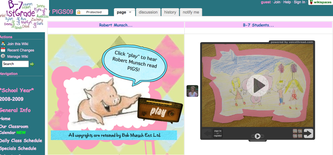
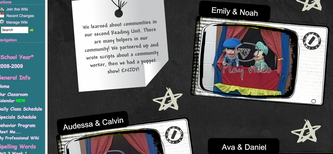
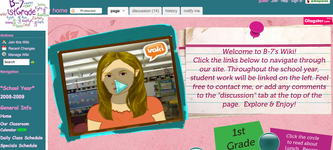
Near the end of the presentation they showed a classroom wikispace…here is a teacher leader at First Grade doing it all with her students--see images below.  Check out her site. 

I will have to think about this day a little longer and then comment on some of the new website they presented.


Getting the right answer: This idea has been an issue for me since I began teaching 16 years ago.  I started teaching in NY and used many resources given to me by an "experienced" teacher.  The guided reading question sheets followed the textbook word for word.  Just fill in the blank.  I knew from an educational standpoint that "higher level questions" were a better option for student growth.  However, from the first time I asked students to response to open ended questions their eyes got bigger and then panic would set in, a look of total fear.  You mean you want me to think?  You want me to have an opinion? You want me to share my ideas?  I soon realized they had not been asked to think, how to read for understand, how to question, in school before,  but they did understand how to skim and find a fill in the blank answer and then memorize that one answer for the upcoming test.   We have trained millions of students to find the one correct answer.  The one answer that is right: December 7, 1941.  But what good is that? How does knowing a fact engage students in learning?  Change the course of a individual? Help them to achieve in the modern world?

Take at look at this exam given to 556 seniors at major univesities (Brown, Harvard, Princeton).  Only one student earned a 100% and the average from these Ivy's a poor 53%.  What this tells us that the factoid is not really relevant in the world today or something that powerful minds will remember. Anyways, who need to memorize them now AG (After Google)--another topic.  
It did not take me long to change the way I was teaching.  No more fill the blanks, no more one word answers.  This was not an easy task and after 15 years, is still not an easy task.  Students are trained to want to find the one right answer--the less said the better.  They have to be taught the difference between "Skinny" (closed) and "Phat" (opened) questions.  They need to understand how to answer each type of question.  They need to be trained to read between the lines for ideas hidden in text. They need main skills for the modern world that filling in the blank will not teach them.  


This is a topic I will come back to, but today when a student said, "Is that the right answer, Mr. Holman?" I had to comment.